

Notes on building smarter websites for actual humans.
A 410-acre park, 3.5 million visitors, and a marketing team of 1.5.
A grant-funded rebuild on Squarespace with live transit and parking data, WCAG 2.1 AA certification, and a site a team of 1.5 can run - for 51% less than what it replaced.
Summary
A grant-funded rebuild of explorewashingtonpark.org: WordPress to Squarespace 7.1, accessibility-first, with real-time transit and parking data - built so a small team can run it for years.
Timeline: Oct 2025 – Aug 2026 launch, three phases
Platform: Squarespace 7.1
Standard met: WCAG 2.1 Level AA
Funding: Travel Oregon grant, with additional investment from EWP
Integrations: Swiftly, Parking Logix, TriMet, Eventually, live weather
Scale: 3.5M annual visitors, 410 acres, 16 attraction and amenity pages
Cost to the organization: 51% less than the previous site and maintenance process, per EWP
The Short Version
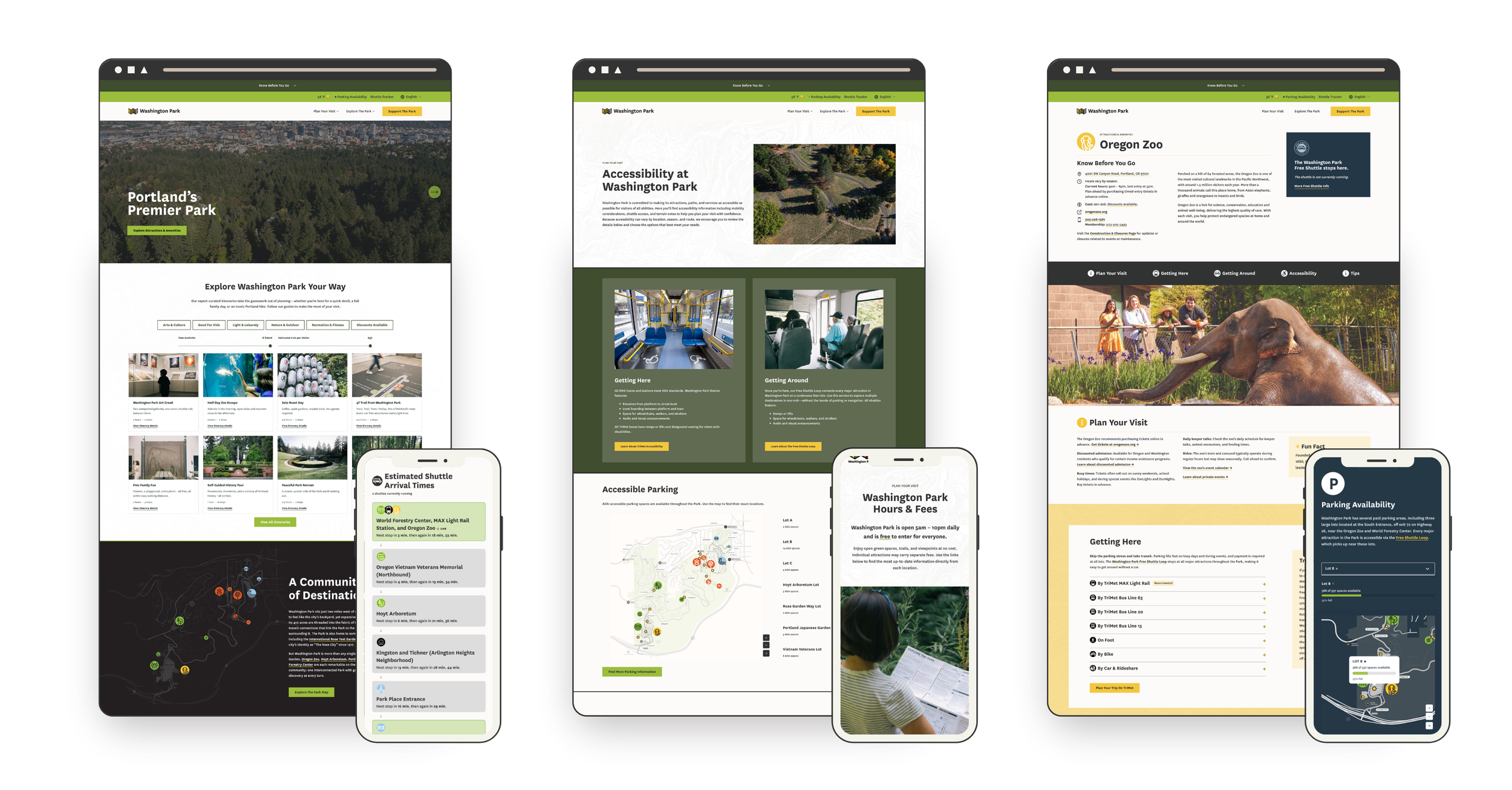
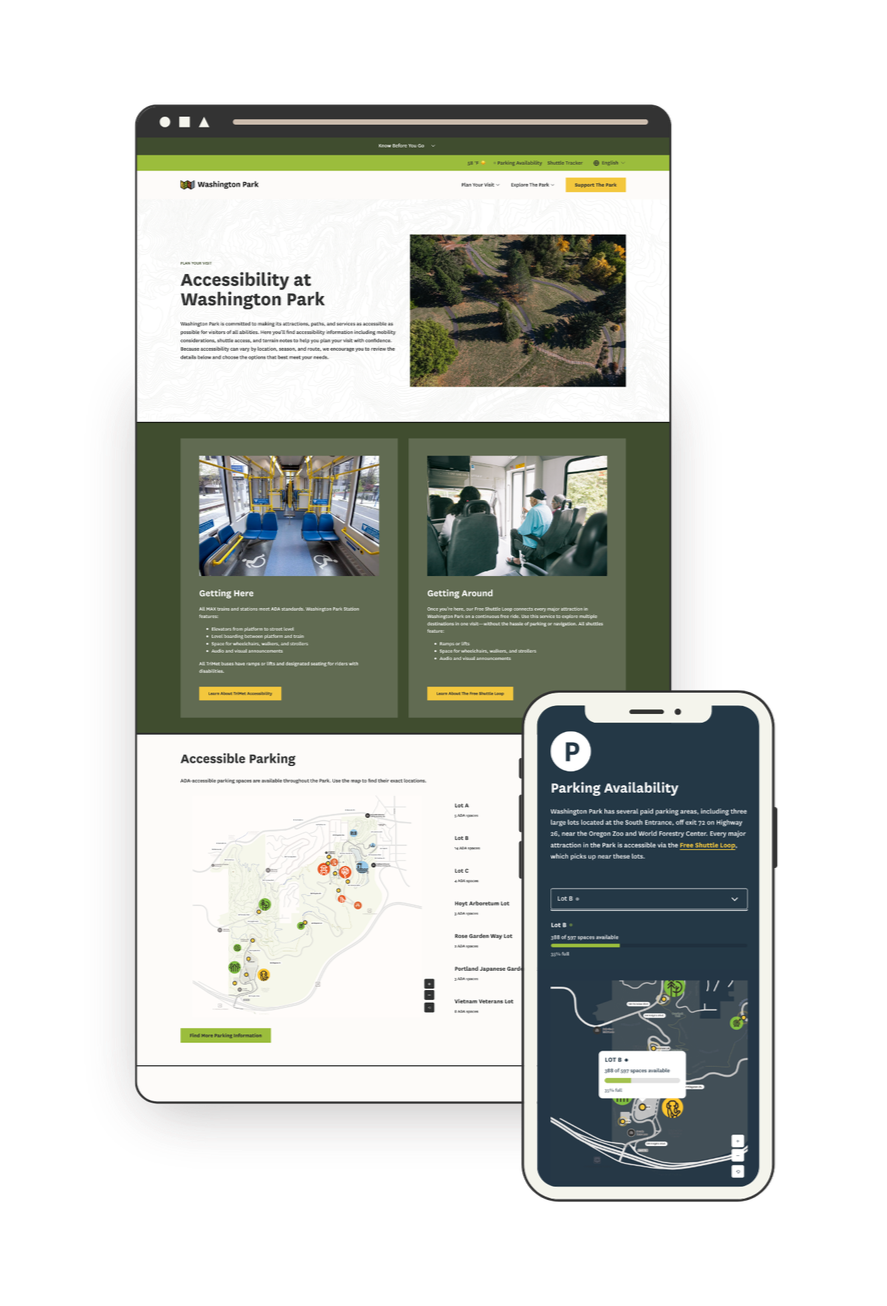
Explore Washington Park manages transportation and visitor services for Portland's most-visited park - home to the Oregon Zoo, Portland Japanese Garden, Hoyt Arboretum, the International Rose Test Garden, and the World Forestry Center Discovery Museum. A Travel Oregon grant helped fund a new site with one job: make it easier to get to the Park without a car and easier to plan your day once you're there. The constraint was that a marketing team of 1.5 people has to own it after handoff. So I built it on Squarespace, with custom development reserved for the handful of things that needed it - live shuttle tracking, live parking availability monitoring, interactive maps, and a feed of expert-curated itineraries with something for everyone - and launched it on schedule at WCAG 2.1 Level AA.
“The final product is better than we could have dreamed: a real-time resource for visitors of all backgrounds and abilities that’s easily managed by Explore Washington Park’s in-house marketing team and costs the organization 51% less than our previous website and maintenance process.”
This was never just a website project
It was Phase One of EWP's ten-year Transportation Access Plan, with a target of moving more of the Park's visitors onto transit and the Park's shuttle loop, a free service that runs daily and stops at every major attraction in the park. Nearly six in ten peak-season visitors travel more than 50 miles to Washington Park, and most of them decide how they're getting to the Park before they leave home. The old site gave them almost nothing to decide with - so they drove, and found out about parking when they were already in it. The goal was to put transit, the shuttle, and live parking data in front of people at the moment that decision gets made, and move the Park's transit share toward the plan's 20% target.
The starting point was an aging WordPress site the internal team couldn't confidently update, which meant every small change was a ticket... and an invoice. The accountability was public grant money, a board, and required reporting intervals with success measures we needed to hit. And the constraint that shaped every technical decision: after handoff, the team has exactly 1.5 people to devote to managing the site on a day-to-day basis.
Doesn't this need a custom build?
A site built against four separate APIs - Swiftly for the shuttle, Parking Logix for parking, TriMet for transit, and a live weather feed - plus custom interactive tools and a WCAG 2.1 Level AA accessibility requirement looks like it needs a custom CMS or a headless build. For a nonprofit, that assumption is expensive both up front and in the long run: a custom build that eats most of the grant before anything launches, a developer on retainer, a stack nobody on staff understands, maintenance debt that outlives the grant.
The actual tradeoff was simpler. Squarespace handles the roughly 80% that staff touch every day - pages, events, content, imagery. Custom development was reserved for the other 20% that needed it, built as isolated, documented components that don't break when someone edits a page. The custom pieces sit on top of native Squarespace features - list sections, portfolios - so staff edit the content underneath the same way they'd edit any other page. This means staff can make updates now and in the future without a developer.
The work nobody sees
The other half of the answer came before the platform mattered at all. Because as tempting as it is to start designing right away, projects like this succeed because the content and structure are solid and strategic. Meghan and I spent the first phase of the project on copy before anything was really designed. Doing this hard content work up front, in a series of Google docs and sheets, may sound like a lot but it's also the reason why the site works. We thought about whether calling a trail "easy" is a judgment or a fact (maybe my easy trail is your hard one). Whether the tone should draw conclusions or give people the information to draw their own. How someone without the budget for a Zoo ticket finds out about free and reduced-cost options clearly and without judgment. What a parent needs to see when they're at the playground with tired kids and it's starting to rain.
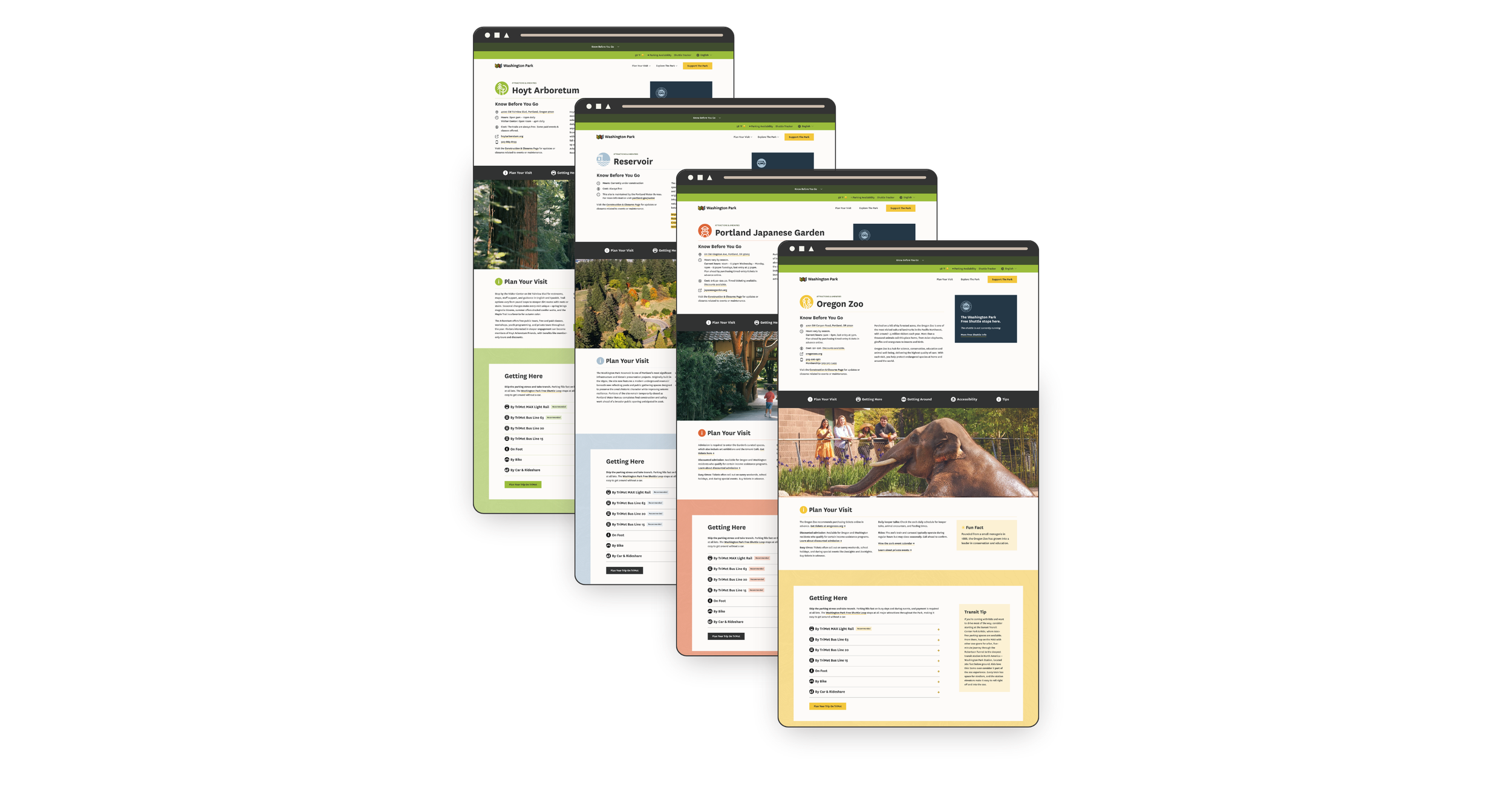
On top of the words themselves, there were 16 attraction and amenity pages, each with its own hours, fees, routes, shuttle stops, and tips - and all of it needed to be mapped and standardized so the site talks about these things the same way on every page, and every page follows the same structure.
A website is wayfinding, so the site borrows from the Park's real signage: a palette that matches the printed maps and iconography that tells people what to expect before they've read a word. On a site like this, that means the answer to whatever someone is nervous about sits in the same place on every page, so nobody has to hunt for it. Once a visitor learns how one page works, they don't have to start over on the next one. (Hint: this predictability is also what makes such a large website maintainable by a small team.)
What we built
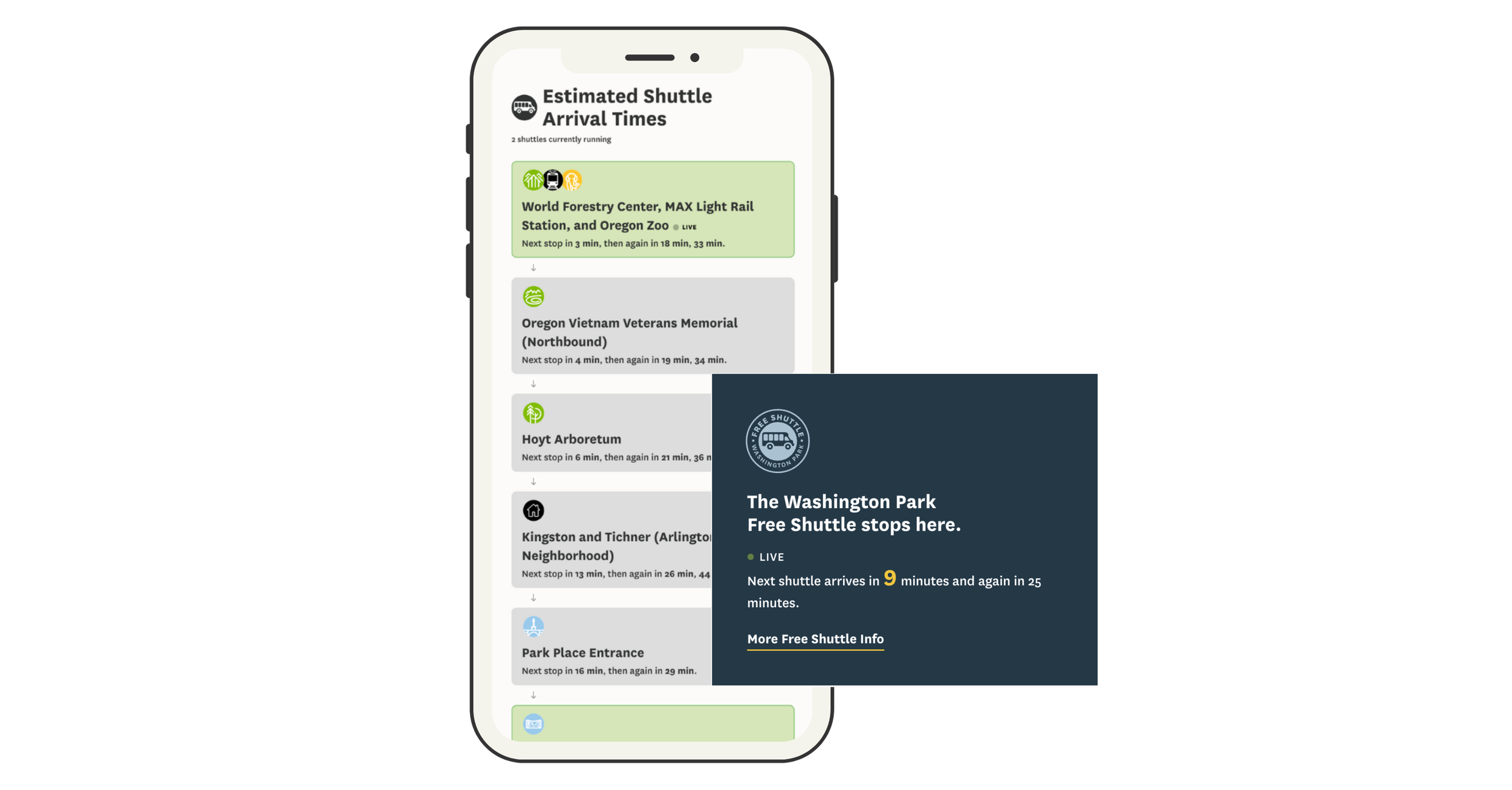
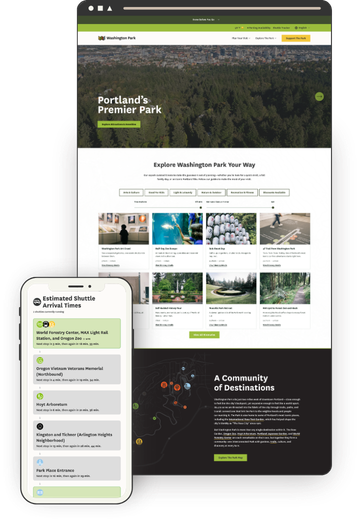
Live shuttle tracker - The old site had a tracker, but it wasn't mobile-friendly, which is a real problem when everyone using it is standing in the Park on their phone. Swiftly data now shows active shuttles, upcoming stops, and arrival estimates refreshing every 30 seconds.
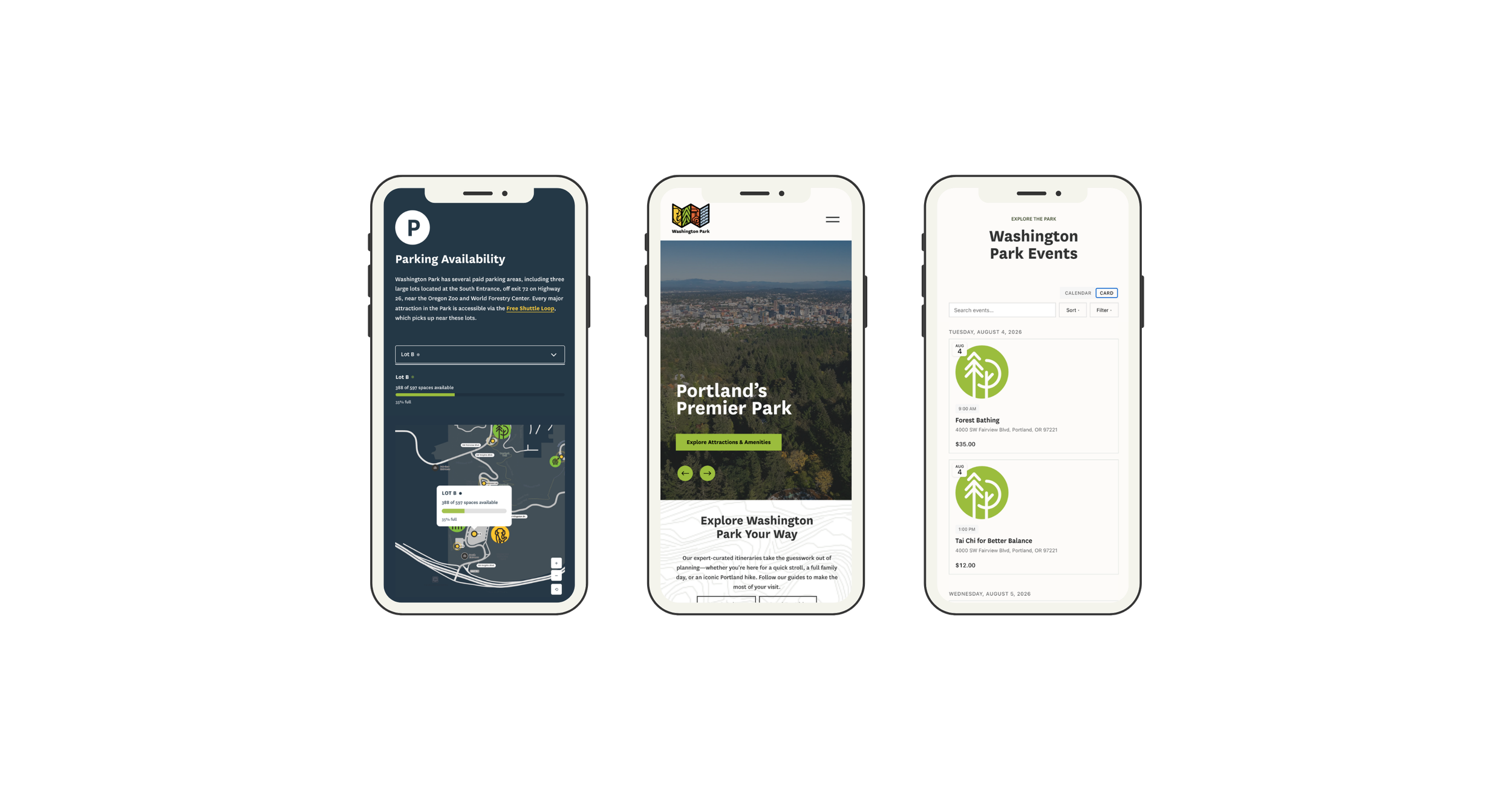
Real-time parking availability - Open spaces for the three major lots from Parking Logix, rendered in EWP's brand on a custom interactive map rather than as a bolted-on widget.
Interactive maps - It's easy to get lost in 410 acres, so giving visitors a sense of where things actually are mattered as much as telling them what's there. Transit stops, ADA parking, rideshare pickup, and car-free entrances, with every marker connected to a location list. Bonus: most map interfaces are notoriously inaccessible, but this custom solution works for all users, including those navigating by keyboard or screen reader.
Itinerary Explorer - EWP's team had already written some great itineraries - things like a Self-Guided History Tour, Cozy Car-Free Exploring, and (my favorite) Dog's Day Out - but they were buried in old blog posts where nobody found them. Now they live in one place, filtered by category, available time, and estimated cost, because "I have 3 hours and I don't want to hike in the rain" is the actual question people are asking. They're built to be fun and shareable, which matters: this is content EWP can now promote instead of just host. Designed so EWP staff can publish new itineraries without a developer.
Transit first - The "How to Get Here" pages don't just list transit as an option, they recommend it above all others: the MAX or a bus is the easy, safe way in, with no traffic and no parking to think about. Every attraction page carries the same message, with the recommended route highlighted and a direct link to TriMet's trip planner.
Events calendar - Each major attraction runs its own event calendar, so this is the one place a visitor can see what's happening across the whole Park at once. When this project started, an events calendar at this level wasn't possible on Squarespace. It is now because of Eventually, an events platform Kelsey Gilbert-Kreiling and Zack Gilbert were building at the same time - I was its first tester, and EWP was built alongside it. Some of what EWP needed found its way into the product along the way, and this site got a calendar nothing off the shelf could match.
Accessibility information - Paved trail information, places to stop for a rest, available accommodations, and what to expect at each attraction, treated as primary content rather than a compliance page. This is the information that decides whether someone visits at all, so it lives where people plan, not hidden in a footnote.
“Having spent the last 20 years working with Squarespace websites, I have rarely been as bowled over as I was by the Washington Park website. Kristine has skillfully pulled together many complex elements and turned them into an incredibly user focused and inclusive website. I honestly couldn’t think of any ways this could be better. This website is truly a model for other venues like this.”
Accessibility as a discipline, not a badge
Accessibility shaped design decisions from the first wireframe, not the final QA pass. When the build was done, an independent consultant, Nicole Nault, audited the site, identified what still needed remediation, and ran user testing. I made the fixes, she verified them, and the site was certified WCAG 2.1 Level AA. The hardest parts were exactly where most "accessible" sites fall short. Heading hierarchy on native elements that Squarespace won't let you control. Keyboard navigation through custom components like the maps and the shuttle tracker, which is why having a developer who structures things properly matters - code thrown together to "just work" doesn't work for a screen reader. And color: I built area-specific color themes from EWP's brand palette so the site could carry the Park's visual identity while keeping text almost entirely black on white.
“Kristine asked smart questions, welcomed feedback, and was always willing to refine the work until we got it right.”
One Person to Call
A project like this has a lot of moving parts: a custom development partner, an accessibility consultant, three data providers with their own APIs, an events platform still in development, a client team, organization partners, and community stakeholders. My job was to take all of that off Meghan's plate, and to be someone she could trust to do it. I decided where I was most effective and when to tap in Will Myers, a key engineer on this project and a true collaborator rather than a subcontractor.
I kept vendors on schedule, timed the accessibility audit so the fixes landed before launch, and reported into the grant timeline - without anyone at EWP having to chase a single thread. And nearly every specialist on this project was someone I'd worked with before, which is the difference between hiring strangers and working with people who already trust each other.
The team included:
Will Myers - software engineer
Nicole Nault - accessibility consultant
Kelsey Gilbert-Kreiling and Zack Gilbert - events calendar
Meg Sheeley - design
Christy Price - consulting
Lily Price - content migration
Results
Launched on schedule and within grant funding. WCAG 2.1 Level AA achieved. Covered by Oregon Business. And per EWP's marketing director, the new site and maintenance process costs the organization 51% less than what it replaced.
“The site’s focus on accessibility and inclusion makes planning a visit easier for everyone.”
The grant's accomplishment report is due in November 2026. Results on visitor growth, trip-planning tool usage, and transit awareness will be added here then.

Telling Your Story in Reverse: Understanding Great UX Microcopy
Strong copy isn’t reactive; it’s predictive. Learn how to “write backward” for your Squarespace site - anticipating what users will think, feel, and need next - to create seamless, story-driven UX that turns clarity into action.
Every website tells a story - but that doesn’t mean it should be written in the order you think.
That’s because most brands write copy for what they want to say. But the best ones write for what their audience is about to feel.
Your visitors are already writing the ending through their clicks, scrolls, and hesitations. The question is: are you shaping the next sentence, or waiting to read it in your analytics later?
This is the art of telling your story in reverse: designing copy around the click, the hesitation, the decision, instead of from the top down.
Start with the Ending
Good storytelling starts with the ending - and so does good UX writing.
If you know what you want someone to feel (confident, relieved, understood) or do (buy, donate, book), you can write backward from there.
That means every headline, button, and sentence becomes a setup for that emotional outcome. Especially the small ones - the buttons, errors, confirmations, and pauses where people decide whether to keep going.
Want trust? Write like you’d explain it to a friend, not a boardroom.
Want confidence? Use language that signals safety and control.
Want excitement? Add momentum through verbs, rhythm, and pacing.
Remember, you’re not writing for a screen, you’re shaping a real person’s decision in real time. You’re setting the stage for how someone will feel and what they’ll do next. That’s powerful.
Every Action is a Line of Dialogue
To better understand user behavior, I’ve found it helpful to think of user actions as a conversation - just one without any explicit words. When someone hovers, scrolls, or abandons - they’re talking to you. They’re saying:
“I’m interested, but not convinced.”
“I don’t understand what happens next.”
“You lost me halfway down.”
This is where microcopy earns its keep. It’s also where writing backwards becomes visible. Those quiet little phrases on buttons, forms, and error messages do more than fill space. They meet users where their thoughts are, answering questions they haven’t said out loud yet.
This is the heartbeat of UX storytelling: not the sweeping brand manifesto, but the subtle reassurance that keeps someone from bailing halfway through the journey. Here’s what that looks like in practice:
Examples:
Form error: Instead of “Invalid input,” say “Almost there - just double-check your email.”
Cart reminder: Instead of “Your cart is empty,” say “Still thinking it over? We saved your picks for later.”
Signup success: Instead of “Thank you for subscribing,” say “Welcome to the good stuff - check your inbox for the first one.”
These micro-moments are dialogue. They keep the story alive.
Anticipate, Don’t React
If your analytics show where people stopped, your copy can predict where they might.
Reverse storytelling means designing each step like a breadcrumb trail - a little Hansel & Gretel moment that guides visitors toward clarity before confusion sets in (minus the weird forest part, of course). Great copy anticipates what someone needs to know right when they need it, so they never lose their way.
That could look like adding short FAQ sections at key points in the journey, using tooltips to explain next steps, or weaving reassurance into form labels and button text. The goal isn’t to overwhelm - it’s to answer the question that’s about to pop into your visitor’s head before they have to ask it.
Ask yourself:
What question will they have right before this step?
What fear or hesitation might come up next?
What can I say here that removes the doubt before it forms?
This is proactive empathy. You’re not waiting for friction; you’re anticipating what might need to happen to remove it altogether.
Bring the Story Full Circle
I see so many sites where the impulse was clearly to throw all the spaghetti at the wall to see what sticks. There’s no plot, no underlying theme — just a lot of noise. And I get it - you need your website to bring in the sales and donations but your website is not a place for you to dump everything and hope for the best.
As website designers and owners, we need to often be reminded that people don’t experience websites all at once. They experience them in bits and pieces, moment by moment. Too often we get in our own way and ask users to do too much.
Every click is a small decision. Every hesitation is a question forming in someone’s head. And uncertainty is expensive. It slows people down, creates doubt, and gives them an easy reason to leave.
Thoughtful microcopy works because it lowers the cognitive load at those moments. It answers the question before it fully surfaces. It replaces friction with reassurance and turns uncertainty into momentum.
This isn’t about being clever or cute. It’s about designing language that helps people feel reassured, in control, and confident at each step as they move through your site. When someone thinks “Oh, I know what happens next,” you’ve already done most of the work.
The Bottom Line
The best websites don’t just look beautiful, they communicate beautifully. Writing your story in reverse means designing every headline, button, and sentence for what happens next. The best feedback you can ever get is when someone says, “I checked out your site and you just get me” Swoon. That’s what it’s like when we write backwards to keep things moving forwards.

Measuring What Matters Without Losing the Plot
Analytics are helpful, but they don’t tell the whole story. This post explores how to interpret Squarespace website metrics with empathy and intention, using UX insights to improve engagement, trust, and conversion without losing sight of the humans behind the data.
If you’ve been around the internet long enough, you’ve probably heard some version of: “what gets measured gets managed.” That’s true, but only up to a point. In web design, the real danger is that once you start measuring something, you risk mistaking the metric for the meaning.
We obsess over numbers - bounce rates, conversions, time on page - but forget what those metrics actually represent: human behavior. Behind every data point is a real person making a decision based on how your site made them feel: clear, confident, or confused.
So instead of chasing better metrics, what if we used them to diagnose where people are getting stuck? That’s where my Clarity → Trust → Action framework becomes a practical lens for what your analytics are really telling you.
Step 1: Clarity Metrics
Are You Easy to Understand?
Clarity is the first hurdle. You don’t earn trust if people don’t get what you do.
Instead of asking “How many people landed on my homepage?”, ask:
How many stayed past 10 seconds?
Which pages have the highest bounce rate - and do they share a confusing headline or layout?
Where are people hovering or clicking that they shouldn’t need to?
Clarity metrics don’t measure volume, they show whether people can get their bearings. If visitors can’t tell what you do in five seconds, they’ll take those clicks elsewhere.
👉 Quick check: Open your homepage and squint. Can you still tell who it’s for? If not, your copy isn’t doing its job.
Step 2: Trust Metrics
Do People Believe You Can Deliver?
Once people understand you, they start evaluating whether to believe you. Trust lives in patterns: consistent visuals, tone, and user experience.
Look at:
Return visitor rate (are people coming back?)
Scroll depth (are they reading or skimming?)
Navigation flow (are they exploring logically or jumping around?)
Trust lives in both the data and the experience people have on the page. You can’t force it with popups or pushy CTAs, you earn it through consistency. Every broken link, mismatched font, or outdated photo chips away at credibility. Every thoughtful touch adds it back.
Step 3: Action Metrics
Are You Moving People Forward?
Once clarity and trust are solid, action should feel natural. But this is where most analytics dashboards go off the rails because we start worshiping conversion rates without asking why people took action.
Look at your actions in context:
Which CTAs convert best (and why)?
Do people complete the checkout or donation process smoothly, or do they drop off part way?
Are you seeing repeat conversions - or one-and-done interactions?
The goal isn’t just more conversions, it’s smarter ones. One rooted in understanding, not impulse. When a site rushes people to buy, it might spike short-term sales but erode long-term trust.
Remember, a good website doesn’t just make it easy to act, it makes it feel right to act.
The Mirage of Measurement
Here’s where it gets tricky. The more we measure, the easier it is to lose the plot. Metrics can only tell you what people did - not why they did it.
A high conversion rate doesn’t automatically mean the experience is working well.
A lower bounce rate doesn’t guarantee people actually liked what they found.
Numbers will show what’s happening, but not whether it aligns with what users need.
My recommendation? View data is a compass, not a script. The numbers can help orient you and provide some rough navigation, but you still need intuition, empathy, and context to interpret what the data means.
Adding Empathy to the Equation
All the analytics in the world can’t capture the complexity of real life. Numbers won’t tell you if someone abandoned their cart because they got distracted by a crying baby, a power outage, or just plain decision fatigue. Metrics capture behavior, not the feelings or circumstances behind it.
That’s why empathy belongs in your analytics conversation. So before we get to what you should be measuring, remember that every data point is a real person. Someone with context, chaos, and competing priorities. This will help you make smarter decisions with your data. You'll be able to stop optimizing for perfection and start designing for reality.
👉 Related read: 12 Ways to Build a More Empathetic Brand
A Smarter Dashboard: Metrics That Matter
Framework Phase: Clarity
Metrics to Watch:
Bounce Rate
Time on Page
What These Really Tell You:
Do people understand what you do right away?
Framework Phase: Trust
Metrics to Watch:
Scroll Depth
Return Visitors
Session Duration
What These Really Tell You:
Are people comfortable engaging with your content?
Framework Phase: Action
Metrics to Watch:
Conversion Rate
Completion Rate
Repeat Actions
What These Really Tell You:
Are you moving visitors from awareness to confidence to commitment?
The point isn’t to hit perfect numbers - it’s to use them as clues. Every conversion, bounce, or cart abandonment is your audience saying something without words. When someone doesn’t click “Add to Cart,” donate, or book now, they’re telling you a story in reverse. You have to put on your little emotional detective hat and figure out what their actions are trying to say through your metrics.
The numbers connect the dots between what we think people want and what they’re actually experiencing. They’re not admissions - they’re context. Little breadcrumbs that lead you toward empathy and better decisions.
The Bottom Line
Measuring is easy. Interpreting is art.
Your analytics should inform decisions, not dictate them. Because the real measure of a great website isn’t how many clicks it gets, it’s how confidently it guides people toward something that actually matters to them.
Good design doesn’t just look good in the data. It feels good in real life. It’s something people can understand quickly, trust easily, and move forward with confidently.

Why Boring Websites Often Convert Better
Sometimes “boring” is just another word for effective.
We’ve all seen those websites - loud, over-designed, stuffed with animations. Why is everything scrolling and floating everywhere? Are we playing a game of chase the button? What is going on??
Sites that are trying to do so much and yet still somehow leave you feeling very, very confused.
Landing on one is like watching a movie that’s all explosions, chase scenes, and stupid sound bites - but at the end you walk out of the theater still wondering what the movie was... about? Flash may grab your attention, but it doesn’t hold it. Without a story or a clear plot, its all just noise.
The same thing happens online when a website tries way too hard to impress without giving visitors something to understand or trust right away.
So here's your permission slip (not that you needed one) but you don’t need a louder website. You need one your audience’s brain doesn’t have to decode.
Because clarity, not chaos, is what earns trust.
We live in a design world obsessed with “standing out,” but the truth is, the sites that quietly guide visitors with confidence are the ones that win. The best part is that this all isn’t just luck - it’s proven psychology. And double bonus? It doesn't take a zillion dollar mega studio budget to pull off.
🎥 Related Watch: Why "Boring" Websites Convert Better
The Science of Familiarity Bias
Humans are creatures of habit. When something feels familiar, our brains release a little hit of safety. That’s familiarity bias - we naturally trust what we recognize. And while we should all work hard to overcome our biases IRL, when it comes to UX and web design it's time to embrace our little monkey minds.
It's why checkouts from Amazon to Target look nearly identical.
It’s why “Add to Cart” buttons are usually in the same spot across eCommerce stores.
It's how we nearly all know to scroll to the footer for more info or click on a logo to go to the home page.
Consistency helps users relax and focus on the content, not the structure. For websites, it’s the same principle. A clear CTA in a predictable place outperforms an experimental layout every time.
Predictability builds trust, and trust builds action.
Cognitive Load: The Hidden Conversion Killer
Every unexpected design choice adds mental effort - what psychologists call cognitive load. The more effort it takes to understand your site, the faster people leave. Because let's face it, we've all got enough going on and are processing just an insane amount of information every day. Unless your site is the NYT puzzles app, I simply do not want to have to work at it.
And I'm not just making this up based on my own inclination towards simple. Studies show that visitors make a stay-or-go decision almost immediately - often within just a few seconds of landing on a page - and the likelihood of them leaving drops sharply after the first 30 seconds, which is forever in internet time.
In short, if they don’t feel confident they can find what they need right away, people will bounce.
Your job as a designer or as a brand owner is this: make every step effortless. Now, this doesn’t mean boring or without friction where needed; it means intentional.
The Predictabile to Professional Pipeline
Predictability doesn’t just make a website feel polished - it signals competence.
When visitors see consistent spacing, steady typography, and patterns that behave the way they expect, they subconsciously read that as professionalism. It’s the same reason we trust brands whose tone and visuals never feel off-script. Basically, consistency = credibility.
The trick here is just to not confuse predictability with sameness.
The best sites balance consistency with a little spark - something that’s uniquely you but still easy to navigate. It’s the tension between structure and surprise that keeps visitors engaged.
If your website were a film, predictability would be the plot structure. It’s what keeps people oriented so your creativity can shine in the details: the cinematography, the dialogue, the pacing. Good design, like a well-told story, gives your audience clarity about what they’re watching and, ultimately, why they should even care.
Familiar layouts don’t just make users comfortable - they make your brand feel established. A calm, structured website signals confidence. An over-designed one often reads as overcompensating. The brands that “feel big” usually aren’t the loudest, they’re the clearest.
👉 Further reading: You Don’t Need More Traffic, You Need More Trust
The Bottom Line
At the end of the day, clarity and consistency aren’t the enemies of creativity - they’re what make it possible. Predictability gives your story structure; creativity gives it spark. A great website blends the two so effortlessly that users don’t even notice the design, they just feel understood.
So, if your site is the movie trailer, your job isn’t to boost the pyrotechnics budget. It’s to make sure people know exactly what they’re signing up to watch and hype them up so that they can’t wait to see more.
That’s not boring. That’s brilliant design.

Think Like a Buyer: How to Map Your Customer Journey
Most websites are built like a checklist. But what if your site could do more than just… exist? Discover how thinking like a buyer and mapping their journey can transform your website into a powerful sales tool, leading to more conversions and happier clients.
Most people design their website like a checklist:
✔ Design homepage
✔ Add services page
✔ Set up contact form
And technically… they’re not wrong. But if you only focus on what you offer (and ignore what your customer actually needs), your site experience can quickly break down. So instead of just building out pages because you think you should, let’s look at what really guides your buyer’s decisions so you can create with purpose.
Because your buyer isn’t following your site structure. They’re following their own journey - one that’s part emotional, part practical, and 100% driven by how well you earn their trust.
If you want more sales, whether you provide services, digital products, or a full-blown eCommerce storefront, you can’t just think like a business owner.
You have to start thinking like a buyer.

You Don’t Need More Traffic, You Need More Trust
Most websites don’t have a traffic problem—they have a trust problem. If visitors land on your site and bounce, it’s not about numbers. It’s about whether your site feels legit. Here’s how to fix that.
Let me guess: someone told you your site just needs more traffic. Because more visitors = more sales, right?
Except… not really.
More traffic won’t magically fix a site that isn’t converting. It just makes the cracks more obvious. If people land on your site and bounce right back out, it’s not because you don’t have enough visitors. It’s because you’re not giving the ones you do have a reason to stick around.
In my experience, most websites don’t have a traffic problem. They have a trust problem.
Most people don’t bounce because your site is bad.
They bounce because they don’t trust it.
You’ve seen these sites before. They’re fine. Clean enough. Maybe even pretty. But something feels... off. You’re not sure who’s behind the business. Or what exactly they do. Or what you’re supposed to do next. Maybe the copy feels a little too vague, or the branding looks too much like a template. So you close the tab.
That’s how fast people leave when they don’t trust what they’re seeing.
And that’s the moment we need to fix.
Because it doesn’t matter how much traffic you drive to your site if the experience on the other end doesn’t hold up. That’s like inviting people to a party and then forgetting to unlock the door and set out the drinks.
What Trust Looks Like on a Website
Here’s the good news: building trust doesn’t mean rebranding from scratch or writing a novel on your About page. It’s not about being fancy. It’s about being real.
Real testimonials. With names. Not just “Happy Customer” from Idaho. I want to hear from a real person who had a real experience - bonus points if there’s a photo, a business name, or a direct quote that shows some personality. The more specific the testimonial, the more relatable it is.
Real language. Drop the buzzwords and say what you do in plain English. If you help people plan weddings, don’t call yourself a “strategic celebration architect.” Call yourself a wedding planner. If you sell pottery, say so. I shouldn’t have to guess what your business is about after reading three paragraphs of poetic fluff.
Real photos. Of you. Of your team. Of your actual product or service in action. I don’t care how beautiful the stock images are—if your customer can’t tell what’s real and what’s filler, they won’t feel confident making a purchase. Even a slightly awkward photo of you at your desk does more for trust than the world’s most curated flat lay.
Real information. Tell me what it costs. Tell me what to expect. Tell me how long it takes, what’s included, and what happens next. I’m not asking you to publish your business plan, but if I can’t answer basic questions from your website alone, I’m probably not going to reach out.
These aren’t major overhauls. They’re tiny little signals that tell your visitors:
✅ You’ve done this before.
✅ You know what you’re doing.
✅ You can be trusted with their money, time, or inbox.
What a Trust Problem Feels Like (And Why It Gets Missed)
Here’s why this is tricky: most people don’t realize their site has a trust problem. On the backend, everything seems fine. The design looks good. The copy sounds “professional.” The buttons all work. But if you're not getting the inquiries or conversions you expected, something's off - and it’s usually not your ad budget.
Trust problems are subtle. They show up in bounce rates and ghosted contact forms. They show up when people say “I love your work!” but never hire you. They show up when you’re constantly fielding questions you thought were obvious from your site.
And the worst part? Adding more traffic just makes it worse. Now you’re paying (literally or figuratively) to funnel more people into a leaky system. It feels frustrating and confusing, because it looks like you’re doing everything “right,” but it’s just not working.
That’s when I tell clients: pause the traffic push. Fix the trust issue first.
5 Fast Ways to Build Trust on Your Website
If this is starting to sound like your site, don’t panic. You don’t need to burn it all down and start over. Here are five quick things you can do to start building trust today:
Add a face to your name. Put a photo of you (or your team) somewhere obvious - your homepage, your About page, even the footer. People like to buy from people.
Clarify what you do in the first sentence. I shouldn’t have to scroll or click to figure out what you offer. Your hero section should tell me what you do, who it’s for, and what makes it valuable.
Feature a recent testimonial front and center. Don't hide your reviews away on a standalone page that no one is going to visit. Pull one or two into the homepage or service page to show social proof where it counts.
Answer the awkward questions. Be upfront about pricing, timelines, and what’s included. Transparency builds confidence - and filters out folks who aren’t the right fit.
Speak like a human. Just write how you speak - no need to be perfect! Basically, if you wouldn’t say it in a conversation, don’t put it on your site. Stop living in fear of a typo or not having perfect grammar - it's ok to let the real you come through.
The Bottom Line
Getting more traffic is great - if your website is ready for it. But if your site isn’t converting, the solution isn’t to throw more people at it. That’s just pouring more water into a leaky bucket.
Fix the trust problem first. Make sure the people already visiting your site feel confident, clear, and connected. Then and only then… start turning up the traffic. Because once your site actually builds trust? Traffic starts working like it’s supposed to.
Not sure if your site has a trust problem? Start by asking a friend (who isn’t in your industry) to scroll through your homepage. If they don’t know who you are, what you do, and how to take action within 10 seconds, you’ve got a trust leak worth fixing.

6 Proven Ways to Create a User-Friendly Online Store
Lost in the digital aisles of online stores? Learn how to transform your shop from a confusing maze into a shopper's paradise. Discover the secrets to intuitive design that keeps customers coming back for more!
Ever walked into a store where everything seemed... off? Like the cashier was hidden behind a plant, or all the price tags were written in a foreign language you don’t understand? Welcome to the digital equivalent of that nightmare - a poorly designed online store. But fear not, we're about to embark on a journey through the wild world of user-friendly design, where we'll discover why putting yourself in your customers' shoes is your secret weapon in the battle for their hearts (and wallets).
1. Easy Navigation: Don't Make Your Customers Feel Like They're in a Corn Maze
Picture this: You're looking for a new pair of snazzy socks on "SuperSocks.com" (not a real site, but wouldn't it be great if it was?). You click on "Men's Socks," then "Patterned Socks," then "Ankle Length," and suddenly... you're staring at a page full of women's scarves. What in the name of mismatched laundry just happened?
This, my friends, is what we call a navigation nightmare. (And it's not fun like a corn maze is.)
Good navigation is like a well-organized sock drawer (sticking with our theme here). Everything should be where you expect it to be, clearly labeled, and easy to access.
Here's how to nail it:
Keep it logical: Group similar items together. Socks with socks, scarves with scarves. It's not rocket science, but you'd be surprised how often this gets messed up.
Use clear labels: "Funky Feet Coverings" might sound cool, but "Socks" is what people are actually searching for. Save the creativity for your product names.
Provide breadcrumbs: No, not the kind that mess up your keyboard. We're talking about those handy little navigation trails that show users exactly where they are on your site.
Offer search functionality: Because sometimes, people just want to type "polka dot socks" and be done with it.
Remember, every extra click is an opportunity for your customer to get frustrated and leave. And trust me, nobody wants to be responsible for sock-related rage quits.
2. Clear Product Presentation: Show, Don't Just Tell (But Also Tell)
Let's face it, we've all been burned by misleading product photos online. You order what you think is a life-sized cardboard cutout of Danny DeVito, and bam! you end up with a 2-inch keychain. Disappointing.
Good product presentation is about creating a virtual "try before you buy" experience. Here's how to do it right:
High-quality images: Multiple angles, pictures of every color option, zoom functionality, and for clothing, please, for the love of all that is holy, show it on a real person. We need to know if that shirt makes arms look like sausages wrapped in fabric.
Detailed descriptions: Don't just say "100% cotton." Tell me if it's softer than a kitten's belly or if it'll shrink the second I put it in the washing machine.
Customer reviews and photos: Encourage customers to post photos and reviews. Nothing builds trust like seeing real people using your products (and looking slightly less photoshopped than your models). People like imperfect!
3. Smooth Checkout Process: Don't Make It Feel Like Running a Marathon
Imagine you're at a grocery store. You've got your cart full, you're ready to pay, and suddenly the cashier asks for your shoe size, your mother's maiden name, and a blood sample. Bit much, right?
Your checkout process should be smooooooth and easy breezy. Here's how:
Reduce form fields: Do you really need to know my favorite color to sell me a toaster?
Offer guest checkout: Some relationships aren't ready for account commitment. It's not you, it's them.
Show progress: Let customers know how close they are to completing their purchase. It's like those "You Are Here" maps in malls, but less depressing.
4. Mobile-Friendly Design: Because Phones Aren't Just for Doom-Scrolling!
Did you know that 79% of smartphone users have made a purchase online using their mobile device in the last 6 months? The other 21% were probably lost in a corn maze.
Here's how to make your mobile experience the best it can be:
Responsive design: Your site should look good on everything from a smartwatch to a smart fridge.
Touch-friendly: Buttons should be big enough for even the clumsiest of thumbs.
Simplified navigation: Nobody wants to feel like they need to be a member of the FBI just to find the "Contact Us" page.
5. Personalized Experience: Make Your Customers Feel Like VIPs (Very Important Purchasers)
Personalization is like remembering your friend's coffee order. It shows you care, and it makes their experience smoother. But there's a fine line between thoughtful and creepy. You want to be more "You might like this based on your recent purchases" and less "I see you're running low on toilet paper."
Some ways to personalize without being a digital stalker:
Product recommendations: Based on browsing history or past purchases.
Tailored email marketing: "Hey [NAME], we thought you might like this" is way better than "Dear Valued Customer."
Remember preferences: If they always sort by price: low to high, maybe do that automatically next time.
6. Inclusive Design: Create for Your Target Demographic, Not Just For Yourself
Designing for all users isn't just nice to have, it's essential. And no, adding alt text to your images isn't just for SEO. It's for people who use screen readers. Remember, not everyone navigates the web the same way you do.
Some key points for inclusive design:
Color contrast: Make sure your text is readable. "Neon yellow on white" isn't a color scheme, it's an eye exam.
Keyboard navigation: Some people can't use a mouse. Make sure your site is navigable with just a keyboard.
Clear error messages: "Oops, something went wrong" isn’t helpful, it’s annoying.
Bottom Line: Let Understanding Your Customers Become Your Superpower
Creating a user-friendly online store isn't about mind-reading (though that would be cool). It's about putting yourself in your customers' shoes, or socks, or whatever it is you're selling.
Remember, behind every click, swipe, and purchase is a real person. They might be stressed, tired, or just really excited about finally finding those elusive polka dot socks. Your job is to make their journey as smooth and enjoyable as possible. And remember, if all else fails, just ask yourself: "Would I enjoy shopping on this site?" If the answer is no, it's time to channel your inner customer-friendly superhero to save the day.

Top 5 Squarespace Shop Mistakes & How to Fix Them
Squarespace makes opening an online store smooth but scaling operations takes strategy. This post reveals the top 5 store management mistakes that may be hurting your growth and actionable ways to get back on track.
Listen, I get it. Setting up an online store via Squarespace offers a ton of out-of-the-box simplicity compared to tackling site design and a pile of code, and the beautiful templates and intuitive CMS make opening up shop online a breeze.
But don’t let that ease fool you - scaling eCommerce operations into a high-performing machine still takes savvy strategy. Without thoughtful setup and smart management choices, what seems straightforward can quickly snowball into an overwhelming headache.
Over my years building websites and consulting for scaling entrepreneurs looking to unlock growth through eCommerce, I’ve seen merchants make some common Squarespace store management mistakes that shoot future success in the foot.
Lucky for you though, these pitfalls are avoidable if you know what to watch out for! In this post, we’ll review five frequent problem areas and - more importantly - how to course correct.
Mistake #1
Improper Inventory Tracking
Without careful record keeping, items get lost in distribution centers and warehouses faster than a banana bread disappears at a farmer’s market.
Problem: Failing to thoughtfully organize inventory into Squarespace’s categories, tags or other filters makes scaling untenable. Plus not actively monitoring stock levels and reordering timeframes means unpleasant sell outs and scrambling to restock hot items.
Outcome: You can’t find product inventory when needed for an order. Items sell out and diehard customers get turned away empty handed. Massive revenue opportunity cost.
Solution: First, logically segment your catalog with categories and nested subcategories so both you and shoppers can navigate quickly at scale. For example, categorize apparel by type (shirts, pants), further broken down by style (casual, dress), gender, brand, etc.
Monitor best selling items and set minimum stock alerts tied to reorder timeframes by leveraging Squarespace’s built-in analytics and integrating an inventory management extension. Data is your friend!
Mistake #2
Complicated Shipping Options
Free shipping or no free shipping? Zones or flat rates? Tiered pricing by item cost or calculated by carrier? Decisions, decisions.
Problem: It’s easy to get excited by Squarespace’s expansive built-in shipping functionality and go overboard configuring a confusing spider web of custom rates, surcharges, and limitations. But this complexity quickly becomes a barrier preventing checkout and you’ll start to see abandoned cart rates skyrocket.
Outcome: Customers bounce from cart when they can’t clearly understand shipping fees or find an option that seems reasonably priced. Plus you sink unnecessary hours fielding customer service inquiries trying to explain variances.
Solution: I cannot stress enough - simple is best! Studies show free shipping dramatically increases conversion. So make that your hero offer as much as possible by baking modest shipping costs into base prices.
For supplementary paid shipping, configure just 2-3 flat rate tiers based on cart value brackets like under $50, $50-$100, and over $100. Publish handling times by common carriers. Be transparent upfront to set expectations. (p.s. This is all great info for an FAQ page.)
Mistake #3
Discounts Devaluing Products
Everyone loves a deal, there’s no doubt about it. But the lure of juicing short-term sales through discounts often backfires over the long haul.
Problem: Rather than special limited-time or targeted offers, you fall into the trap of keeping items perpetually “on sale” through sitewide promo codes plastered on your site.
Outcome: Customers quickly become trained to only purchase when receiving a discount and abandon carts or hold off buying items at full retail value. Your products seem meaningless without deals.
Solution: Shift promotional focus from widespread price cuts to exclusivity. Highlight specialty collaborations driving scarcity. Use segmented emails with special subscriber sales. Offer new customer discounts but fade them over time through customer lifetime value marketing.
Sparingly advertise discounts around seasonal launches or holidays using banners - then quickly revert back to regular prices. You want to seem generous at times without eroding product value. (Check out this post for more pricing psychology tips.)
Mistake #4
Gaps in Inventory & Order Visibility
With countless product details and customer orders to track daily, it's easy for gaps in visibility to emerge if you’re not proactive.
Problem: Relying on manual spreadsheets and notes rather than a centralized system leads to order processing delays, inventory blindspots, lack of customer purchase history, and more.
Outcome: You oversell out-of-stock items, mishandle customer data, respond slowly to fulfill orders without a 360-degree view. And with no analytics insights, you miss sales trends.
Solution: Eliminate blindspots by centralizing critical info and workflows into Squarespace’s stock tracking, order management, and customer profiles. Standardize order processing procedures. Export analytics reports to make smart decisions based on data.
Staying on top of the details can help you know when to cut items from your inventory, understand which customers purchase most often and help you streamline your back office procedures. Start leveraging the platform tools available to you!
Mistake #5
Transactional vs. Personalized Customer Experience
In the early days of your business, my guess is that you were on a first name basis with every shopper. And while growth is good, it’s easy to forget how important personalization was in making it all happen.
Problem: Once you scaled, customers became faceless transactions rather than unique individuals with preferences and a previous purchase history with your brand.
Outcome: Failure to make shoppers feel special can send them elsewhere to shop, which also means you miss out on referrals and community enthusiasm from loyal brand advocates.
Solution: Tap back into the CRM power built right into Squarespace like saved customer profiles and order data. Segment users by lifetime value bands so your VIP shoppers feel appreciated through special treatment and exclusive offers.
Send post-purchase surveys to identify pain points requiring attention across the buying journey. Personally respond to negative reviews. Have loyalty or affiliate programs that foster community among top fans.
Remember - personalized customer experiences drive measurable revenue gains, increased retention, valuable insights, and free word-of-mouth promotion! Don’t leave that money on the table.
Bottom Line
While it's easy to fall into these common eCommerce pitfalls, the good news is that they are all avoidable with a bit of diligent preparation and process focus upfront. Leverage the tools already available in your Squarespace platform and think proactively. Carefully organize behind-the-scenes workflows just as thoughtfully as you design the customer-facing storefront. Monitor key metrics. Continuously gather feedback. And never lose sight of the individual people who make this business possible - your customers!
By taking the time to purposefully streamline operations and experiences, you equip your brand for scalable, sustainable growth. So be confident in your path forward, learn from mistakes, and continue delighting shoppers - that's the recipe for long-term eCommerce success.

The Importance of Accessibility in Web Design
Web accessibility is essential for creating an inclusive online experience. It helps websites reach a wider audience, improve search engine rankings, and reduce maintenance costs. Here’s how to do it.
Dream scenario: A world where everyone is able to enjoy every website online, regardless of their ability.
Accessibility has been a topic close to my heart for years. It's not just about creating an inclusive online experience; it's about ensuring that every individual, regardless of their abilities, can access and engage with digital content. In this post, I want to emphasize the significance of accessibility in web design, provide you with practical tips to make your website more inclusive, and share my favorite accessibility tool. But first, let's talk about why accessibility matters.
Designing for All
When we discuss accessible design, we often think about people with permanent visual, auditory, or cognitive disabilities. However, the scope is much broader. Accessibility also encompasses those with temporary disabilities as well as individuals with varying levels of ability, like the elderly. Additionally, we must consider users with limited internet access or those who rely solely on mobile devices to browse the web. It’s why designing with empathy is so important. By designing with inclusivity in mind, we ensure that everyone, regardless of their situation, can access and navigate our websites seamlessly.
Four Tips for Creating an Accessible Website
Keep layouts clean and minimal: Cluttered layouts not only hinder comprehension but also pose challenges for interaction. Design your website with a clear and intuitive structure, making it easy for visitors to find information and take desired actions. Remember, simplicity is key.
Use color wisely: While aesthetics play a vital role in web design, it's important to go beyond visual appeal. Consider users with color blindness or those accessing your site in challenging lighting conditions. Provide high contrast elements and alternative visual cues to ensure that your content remains accessible to all.
Put alt text, metadata, and links to work: Enhance both user experience and search engine optimization by incorporating descriptive alt text for images and providing additional context through captions and text transcripts for multimedia content. Avoid using vague hyperlinks like "read more here" and opt for clear, descriptive language instead.
Remember, boring and consistent can be good things: While innovative design concepts are exciting, when it comes to web accessibility, consistency is key. Users rely on familiar structures and functionalities to navigate websites efficiently. By sticking to established design patterns, you create a more inclusive and user-friendly experience.
Everyone Wins with Inclusive Design
By implementing accessible design principles, you not only ensure that your website is available to a broader audience but also reap various benefits. Accessible websites tend to:
Perform better in search engine rankings 📈
Reduce maintenance costs 📉
Increase audience reach 🌎
As technology evolves the long story short is that we all benefit from accessible design, whether we interact with the web through smartphones or voice assistants, screen readers or other accessibility tools.
How to Make Your Website Accessible Today
Designing an accessible website is not only the right thing to do, but it's also essential for legal compliance. The Department of Justice has made it clear that business websites should align with specific accessibility standards. Non-compliance can lead to potential lawsuits, putting your business at risk. But don't worry, I've partnered with accessiBe to provide you with a simple, streamlined solution.
accessiBe is an AI-powered web accessibility solution that ensures your website complies with WCAG, ADA, and other accessibility regulations. By incorporating accessiBe, you empower individuals with disabilities to adjust how they view and interact with your website without compromising the codebase, layout, or design. With accessiBe's continuous monitoring and personalized reports, you can easily prove compliance and maintain an inclusive online presence.
Remember, designing for accessibility isn't just about meeting legal requirements; it's about embracing diversity, empathy, and equal opportunities. Join me in creating a digital landscape that truly serves everyone with accessiBe!

How FAQs Can Boost SEO and Customer Satisfaction on Your Squarespace eCommerce Website
Are you looking to enhance your online business and provide a seamless customer experience? Discover the power of FAQ pages! Learn how FAQs can answer burning questions, boost trust, save time, smooth the shopping experience, showcase your expertise, and amp up your SEO awesomeness.
Real talk: FAQ pages aren't exactly the most glamorous topic in web design. Let's face it, no one starts a conversation about their website by raving about their awesome FAQ page. But here's the thing: FAQ pages are often overlooked or added as an afterthought, leaving visitors searching for missing information. That's why I believe it's smart to include a FAQ page right from the start, even if you're not sure how "frequently" those questions are asked!
Here are my tips to ensure your FAQ page does its job:
Pay attention to design & organization: While FAQ pages may seem a bit mundane, they don't have to be ugly. Organize your page effectively using accordion menus, tabs, or dropdowns to prevent it from looking overwhelming. Headers and subheaders can make the page skimmable, and anchor links improve the user experience. Function matters more than form, but a messy FAQ page can be a red flag.
Answer the questions no one asked: Sure, FAQs are meant to address frequently asked questions, but they can also be an opportunity to showcase your brand's personality. Consider including questions that no one would think to ask, but that allow you to share a bit of your brand's story or values. Think of them as the "I'm so glad you asked that" type of questions.
It's okay to repeat yourself: Don't assume that visitors have read every page on your site. Even if you have a dedicated shipping page, include shipping-related FAQs on your FAQ page. People tend to skim websites, so your FAQ page serves as a highlight reel of important information from across your site. Include key details that visitors may have missed and provide links to relevant pages for more in-depth information.
If you're unsure about what to include on your FAQ page, here are some ideas:
Contact information
Unique selling points of your product or service
Guidance on choosing the right product/service
Things customers might need to know but haven't thought to ask
Return policy
Shipping options and timelines
Password reset instructions
Refund policy
In a nutshell, every website can benefit from a well-crafted FAQ page, even if it's short and sweet. Think of it as an opportunity to educate your customers and build their confidence in doing business with you. A well-organized FAQ page with thoughtful answers shows your commitment to providing exceptional customer support. So, let's give your visitors the answers they're looking for and create an FAQ page that truly shines.

5 Simple Steps to Optimize Your eCommerce Site for Mobile Sales
With mobile purchases making up about half of all eCommerce sales, it's important to optimize your website for mobile sales. It’s not enough to just put your products or services online for people to discover. You’ve got to make sure that your site is designed for selling on devices big and small.
It's highly likely that your clients or customers are searching for your products or services on their mobile phones, regardless of what you sell. In fact, some estimates suggest that mobile purchases account for roughly half of all eCommerce sales! This means it's crucial to consider these users when designing your website. They don't just want information about your company or offerings; they want to take action, make purchases, enroll, sign up, and connect with you. For many users, the entire process from research and discovery to purchase and beyond occurs on their mobile devices.
Is “Mobile First” outdated?
Web designers have been discussing "mobile-first" web design since the first iPhone was released, but as with all things tech, there have been numerous improvements and changes over the years. Mobile-first design simply means that instead of designing a website for desktop screens first and then attempting to scale it down to fit mobile devices, it may be more effective to approach it the other way around.
While this buzzword is relevant when considering eCommerce, modern web design platforms like Squarespace and Shopify now handle responsive design so well that we don't need to focus as much on creating two separate experiences. Instead, it's more important to build an empathetic brand that considers the distractions and emotions users may experience while visiting your site. This entails paying attention to your content, organization, structure, layout, and site architecture just as much as the design of your website.
So, knowing that mobile commerce is something we need to think about as we take all phases of our interaction with brands onto our phones, here are five things you can do to optimize your website for mobile sales.
1. Have your site built on a platform that does eCommerce well.
If you're considering building your eCommerce site on Squarespace or Shopify, you're already ahead of the game! Page layouts on both platforms automatically adjust to any screen size, from the smallest phone to the largest desktop. This is crucial because users prefer vertical scrolling on small screens rather than having to zoom in or scroll sideways. Plus, Google rewards mobile responsiveness with higher search engine rankings!
If you're struggling to make your design work seamlessly on mobile devices, Squarespace 7.1 Fluid Engine has got you covered. With the added feature of adjusting layouts exclusively for mobile, you can create bespoke designs that cater to users on varying screen sizes. For more information on Squarespace 7.1 and its impact on eCommerce sites, be sure to read this post.
2. Pay attention to site speed.
Slow loading times can be detrimental to your website's success, not just because it's frustrating for users. Google takes note of this and may penalize your site accordingly. To improve the speed of your site, pay attention to page size (keep them under 5 MB) and image size (below 500 KB or with a width of no more than 2500px). You can easily compress or downsize your image files using free online tools before uploading them to your site. If you're experiencing slow loading times, start by reducing your image sizes. If you're interested in doing more to optimize your Squarespace site's SEO, I highly recommend SEOSpace!
3. Consider a minimalist’s approach to visual content.
Some design trends may look stunning on a 27-inch iMac, but they can be a disaster when viewed on mobile devices. There’s a fine line between designing for the sake of design and designing for conversion. Every aspect of your website, from headlines to images to text blocks, buttons, and even white space, should serve a purpose. If an image looks great on your giant desktop but crops weirdly on mobile, it’s not going to work. And you’d be remiss to sacrifice the mobile experience for the sake of desktop aesthetics.
Keep in mind that things need to work when stacked vertically, one element at a time, which is how they are viewed on mobile. You’ve only got a few scrolls to get your point across or visitors will abandon your site - most likely off to one of your competitors.
Struggling to keep your design in check? Check out my post on this: A Minimalist’s Guide to Branding
4. Navigation matters more than page content.
I want to emphasize that your page's content is crucial, but I often see clients fixate on minor details for a paragraph buried deep in their website while neglecting the organization of their site as a whole. The way you structure and present your information, known as information architecture, is vital to your site's success, particularly if you want to appeal to mobile users.
Of course, page content matters too - visitors shouldn't have to struggle to understand what you're offering. To be mobile-friendly, prioritize smart content and intuitive navigation. For eCommerce sites, consider using categories and subcategories to thoughtfully nest information. When it comes to main navigation, keep titles brief and limit the number of links. Or consider one of my favorite suggestions: replace your typical website navigation (Home, About, Contact) with your shop categories instead!
For more on making sure your site is as user-friendly and easily navigable as possible, check out this post: UX Lessons from a Former Sign Designer.
5. Make checkout easy.
If you’ve done all of the above and got someone to add something to their cart, don’t make it hard for them once they get there! To optimize the checkout experience, I highly recommend minimizing the amount of information required. While it may seem beneficial to gather additional details such as a customer's birthday or how they found you, these actions create friction that can lead to lost sales. The checkout process is not the ideal time to get to know your customers better. Instead, consider shifting all extraneous communications to a weekly newsletter, social media feed, or personalized post-sale follow-up email. For more information on setting up product-specific email automations, check out this helpful guide.
Bottom Line: Elevating the Mobile eCommerce Experience
To maximize your mobile sales, it's crucial to pay attention to the small details. Keep in mind that your customers may be distracted or in a hurry when browsing on their mobile devices. Therefore, your goal should be to make it as easy as possible for them to discover and purchase your products. With the increasing number of mobile shoppers, optimizing your website's size, content, and checkout process is more important than ever. For additional web design tips, check out this post: Website Tips from an eCommerce Pro!

Ecommerce Pricing Strategies That Will Help You Increase Your Bottom Line
Pricing strategies are some of my favorite things to explore because it's just so fascinating how our consumer brains work. These aren't tricks, just proven ways to help you sell more on your eCommerce site.
Updated July 2022
Something everyone in business struggles with is pricing. If things sell quickly, we worry that maybe we could have priced higher and made more money. If things aren’t selling at all we are quick to cut prices, rationalizing that “any sale is better than no sale” and eat away at our profits in the process.
The thing about pricing is that getting it right isn’t just dumb luck. There are strategies (with actual science and psychology to back them up) that can help you figure out how to position your products and services to optimize profit.
1. Cheaper Isn’t Always Better
This is an example of how what you say about your pricing matters almost as much as what the actual price is. (Copywriters worldwide are applauding me right now!) Imagine someone selling fake designer sunglasses on a street corner. Their only sales pitch is that they are cheaper than their competition (either other fakes or the real thing). They don’t tell you why (inferior materials, cheap labor, potentially stolen goods, whatever), they are just telling you that you’re not going to find a cheaper pair of sunglasses anywhere. Do you buy it? Of course, you don’t! Because your mind immediately thought it was a scam or a trick. Why would they be pointing out their competitor’s pricing if there wasn’t something great about their own product that they could promote instead? Leaning on price alone as a differentiator is a race to the bottom.
Takeaway: Don’t mention your competitors or their prices unless you can also provide damn good reasons why you’re a more affordable alternative. Explain that you have better purchasing power or a more refined process or more high-tech manufacturing facilities or whatever it is. Let that be the differentiator and the pricing won’t matter.
2. Give Them a Price Anchor
Price anchoring is a nifty little pricing psychology hack that I often compare to the jewelry case at Costco. Have you ever lingered a while at the Costco jewelry case? It’s a price anchoring master class. Why? Because there is always that one singular engagement ring that is glittering and giant and comes with a price tag of something like $99,193.74. This makes you laugh in horror because who in their right mind would buy this? No one. But you know what suddenly looks super awesome? That very reasonably priced and almost as sparkly stunner right next to it. Why does Costco put this anchor ring in the case? To make the prices of all other rings seem like a bargain. Once your mind has been shocked by the first price, all other prices will seem reasonable by comparison.
Takeaway: When giving people options, make sure there are perceivable differences in cost and value. On the off chance someone goes for your super-premium option you’re in the money but in the everyday scenario, the item you really want to sell will seem like the best deal by comparison.
3. Play With The Digits
There are tons of different articles, strategies, and theories out there about how the way we present the price of what we’re selling affects the bottom line and they can all agree on this: when in doubt, shift the digits up or down.
Down Shift (Charm Pricing)
Charm pricing is so ubiquitous that it’s everywhere and even though we’re all super aware of it, none of us seems to be immune to it. It is wildly effective! It’s basically reducing the price by one cent to a number that ends in 9 (or 5, but 9 is more popular).
So: making something that is $10.00 ➞ $9.99
Why this works: scientists aren’t 100% in agreement on why but one theory is that because the price is specific that we feel like its value is calculated very precisely. Others say that because we calculate the value of a product or service based on the perceived loss that we read $9.99 as cheaper than $10.00 or that we feel like we’ve saved money by buying something for $9 rather than $10.
Up Shift (Prestige Pricing)
On the flip side, shifting prices up by a cent or rounding them to even numbers and removing the decimals can have equally powerful effects.
For example: making something that was $197.82 ➞ $200
Prestige pricing works well in situations where you’re selling based on emotions and feelings and less on rationale. For example, if you’ve positioned your product as the premium option in the market shifting the price up to a round number can help validate the copy and drive up sales. Where $197.82 would be perceived as a “sale” price or markdown, $200 feels like the right type of price for something premium.
Takeaway: Depending on your positioning, shifting your prices up or down a digit can have a big impact. The most important thing is that the pricing layout (how the numbers themselves are actually presented) aligns with the copy and positioning of your product. Buyers are quick to suss out any sort of dissonance between what they’re being told and what they’re being sold so if your copy says premium but your price says discount, they’re going to click away.
4. Use Price Tiers to Your Advantage
This principle seems to almost contradict #1 above but there’s a method to the madness, I promise! This one comes from Priceless: The Myth of Fair Value which is a great book if you’re into this topic like I am. If this book doesn’t exactly sound like your idea of a fun weekend read, no worries, here’s the breakdown of one of the studies which may blow your mind a little at first but will definitely help you structure your price tiers better!
The study looked at beer purchasing patterns (as all good studies should).
Round 1: Two beer options
Out of 100 Beers Sold:
Outcome: People preferred the fancy beer 4 out of 5 times.
Round 2: Two original beer options + with a new option priced lower
Out of 100 Beers Sold:
Outcome: Now the premium beer seems too expensive and since the cheap beer is priced so closely to the mid-range beer, the midrange beer seems like the best option.
Round 3: Two original beer options + with a new option priced higher
Out of 100 Beers Sold:
Outcome: Surprise! People like nice things and some people will always buy the most expensive option but now the mid-range (formally premium) choice seems like the smartest way to go.
Takeaway: If you’re going to bracket your prices into tiers, always anchor up as opposed to down. Cheers!
5. Limit Their Choices
It has been proven time and again that among our many great skills as humans, making decisions amongst too many options is not one of them. Shoppers given too many things to choose from will often opt to do nothing or defer a purchase because 1) we know we suck at making decisions and fear making the wrong one and 2) we tend to over-analyze things that are presented as very complex sending us into “analysis paralysis.”
In the example of using pricing tiers (above), a safe max is three. And if you’re thinking right now that if three options are good then 10 must be better let me tell you NO. Wrong. Stop this.
Takeaway: If there isn’t much difference between similar products or services you offer, consider eliminating or consolidating to present fewer options to your customers or clients. Offering a curated selection of products or services will almost always beat offering an endless array of options shoppers feel bewildered trying to sift through.
The Bottom Line (Pun Intended)
When working on pricing for your online shop or eCommerce store, it’s important to think about all of the different factors that can impact whether that “Add to Cart” button gets clicked. It’s certainly not simple but it doesn’t have to be a guessing game either. Taking some time to familiarize yourself with various eCommerce pricing strategies can help you feel more confident in setting your prices while also improving your bottom line.

5 eCommerce Trends You Can't Afford to Miss Out On
These trends are easy to implement but will have a major impact on your shop experience AND your bottom line! You’ll be pleased to know that this list doesn’t feature any zany design ideas that will look outdated next week but instead will show you how to better connect with today’s online (and in person!) shoppers.
There’s no doubt at all that the world of eCommerce has seen some major booms and changes over the last few years. With more people than ever shopping online - and more small businesses than ever starting to sell online to meet those demands - there are some clear trends that don’t seem to be going away anytime soon.
There are a couple of underlying themes to these trends worth noting. The first is that customers want to feel secure and confident in shopping online above all else. They aren’t necessarily looking for edgy website designs or really outlandish features. The things that motivate people to buy are simple, easy-to-implement ways that just provide reassurance that you’ll be there for them if they need you.
The second theme is that people are looking for mixed online and offline shopping experiences. So if you have a brick-and-mortar store, retail shop, or popup location - use that to your advantage on your website! Your IRL customers see your website as a continuation of the in-store experience, not necessarily a replacement for it and vice versa. You can lean into this overall theme by implementing the ideas below that allow for online customers and real-life shoppers to become one and the same.
Trend 1
Have a generous return & exchange policy.
Having a generous return policy is one of the absolute best things you can do to boost online sales in 2022. Study after study shows us that online stores that offer returns (or better yet, FREE returns) and exchanges perform better than those that don’t. For people who are hesitant to shop online or even just those who are new to your brand, touting your return policy in multiple places on your site is an excellent conversion booster.
How to do it: How to Manage eCommerce Returns on Your Small Business Website
Trend 2
Offer a Buy Now, Pay Later payment option.
I’ll be honest, I thought the whole “buy now, pay later” thing was going to be a short-lived thing that died out by now. But, boy, was I wrong. Shoppers love this option, especially younger shoppers who are leary of amassing credit card debt. It’s also easy enough to add an option like Afterpay to Squarespace that I say just toggle it on so that it’s there for those who want it. A lot of people will still opt to pay traditionally but you may see a small uptick in sales by appealing to those who may have been hesitant to shop without this option.
How to do it: How to Enable AfterPay on Squarespace
Trend 3
Create a Local Pickup option on your website.
This is one of my personal favorite options when I’m shopping online as it helps both me and the place I’m buying from save a little on shipping - and it can be a little greener, too! Local pickup options combine the best of both worlds; people can browse and shop online but then still drop by to pick up their order. Studies also show that this can lead to an uptick in in-person purchases too - win, win! Think of it just like all the candy and goodies in the checkout lane at the grocery store; you’ve technically already finished your shopping but it’s just so tempting to add a little extra something at the last minute!
How to do it: How to Set Up Local Pickup or Curbside Delivery on Squarespace
Trend 4
Display helpful alternatives to any out-of-stock options.
Oh man, it’s frustrating when you think you’ve finally discovered the perfect product for you only to find that it’s out of stock! Shoppers understand that supply chain issues and shortages may mean that you’re running inventory pretty lean and mean but don’t miss out on an opportunity to sell them something else they may love just because their first choice is not available.
I recommend using some of the built-in merchandising features in Squarespace like related products or product waitlists to prevent online customers from reaching a dead end. If you want to get even fancier, you could also add URL redirects for out-of-stock products so that people land directly on your preferred alternative (just make sure to mention that in the copy otherwise people will be confused).
Related: Built-In Features to Help You Sell on Squarespace
Trend 5
Add a chat option to your site.
I swear to you I’m not writing this post with just all of my favorite things as an online shopper myself but I love this one as well! And this is also another one where the stats confirm it works: the majority of people surveyed say they not only expect a live chat option but use it as an indicator of how good a shop’s customer service is overall.
In this post, I dig into what I call the idea of “Conversational Commerce” but the whole point is that you can (and should) be using live chat as a competitive advantage over your competitors. Nowhere else online are you able to have direct 1:1 conversations with your customers and help guide them to exactly what they’re looking for. You can’t have those conversations via social media or even email. Live chat is a way to bring what makes you special in-person to your online space.
How to do it: Best Live Chat Widgets for Squarespace
Bottom Line
These are some trends I can get behind! I love that when it comes to eCommerce people have shown that what they’re looking for are clarity and connection. They want to be reassured and to feel confident in their buying decisions. They want to know that there are real people behind the brand and they want to communicate with YOU! If you’re looking for ways to increase sales or build your audience, I suggest starting with the 5 things on this list. I can guarantee your audience will love them!
Looking for more? Check out: 7 Ways to Build Trust (and Boost Sales) on Your eCommerce Website

More Great Squarespace eCommerce Templates
I searched high and low so you don’t have to! Check out some more of my favorite free and paid Squarespace templates and why they’re great for eCommerce!
My post The Best eCommerce Templates for Squarespace features some great templates but there’s are so many to choose from that I’m back with another roundup of faves! Some of these I may like even more! For the new or uninitiated, Squarespace templates are a great jumping-off point that allow you to get to launch day faster and more affordably than starting from scratch. Templates are also great for eCommerce projects because they take care of a lot of the heavy lifting when it comes to design and layouts so that you can focus your energy and resources on the thing that really matters - your shop!
Another thing to note is that all of the templates I feature are for Squarespace 7.1. This is the newest version of Squarespace and one of the things I love about it (aside from all these awesome eCommerce upgrades) is that all templates have access to all features and functions; you no longer have to worry about picking a template based on what it can or can’t do - they all work great!
p.s. if you’re not sure what to even look for in a template, this is a great place to start: How to Pick the Right Squarespace Template for Your eCommerce site.
Free Built-In Templates
Free is a good price and all these templates are part of Squarespace’s included template gallery so you can just jump right into editing! Remember that it’s important to look at the content areas a template has as much as the style; you can (and should!) always change fonts and colors to suit your brand. Also, don’t get turned off on a template just because the demo content features a specific industry other than yours. Once your products and brand are added, any of these templates would work great for just about any eCommerce shop!

SKYLOOP
What I like:
Skyloop is super fun and vibrant right out of the gate but it’s still super clean and minimal! This template makes the list because it is so explicitly eCommerce-focused that I think it would make it easy for people who are struggling with seeing the selling potential of other templates. This one already features links to featured shop categories and super clean shop navigation which are nice selling tools. Overall this template is a great jumping-off point!
What I would add/change:
This template is really engaging so there’s not a lot I would change although I do think it would be nice to move the subscription box that’s featured on the home page into the footer so that it will be visible on all pages. I also think that every shop needs an FAQ page so I would add that and then possibly incorporate the shop categories into the footer navigation so that visitors can have access to that info again at the bottom of the page.

PASSERO
What I like:
Yum! Doesn’t just looking at this template make you hungry?! I love it for its great “above the fold” image and strong CTA but the home page also has room to highlight features of working with you or shopping from your site. The demo content is set up for a membership site but you could just as easily make those buttons to schedule with you or visit shop categories. The classes page could highlight any number of things like blog posts or help articles - even favorite products! I think this template really shows some of what’s possible on Squarespace in a fun way!
What I would add/change:
I think the footer could be made stronger with a newsletter signup linked to Squarespace campaigns - so that you could automatically send new clients or customers an offer! It may also be cool to embed an Instagram feed to add some dynamic content. I also really like the photos about midway down the demo home page but I don’t love that they don’t link anywhere. It would be really cool if those linked out to corresponding recipes, services, or products to make the site even more interactive!
MACA
What I like:
The vibrant colors of Maca just make me happy - and I’m not even a big fan of purple! 😂 The beauty of this template is that I think it would work great even if the colors were toned down a bit. The home page of this template is also super robust with lots of content areas for everything from fave products to shop categories, informational content, and even product features. I also really appreciate the mega footer on this site - everything a customer would need is linked right there while allowing the top navigation to remain simple and tidy.
What I would add/change:
I would definitely turn on the built-in shop category navigation to help people explore the shop better. On Squarespace, you can have up to three levels of nested categories so with lots of products it’s best to put that to use to help people find what they’re looking for quickly. Speaking of categories, I would throw those in the site header just for good measure! Overall, there’s not much not to love with this template!
Paid Templates
Third-party templates like those featured below can be a great way to get a little more style and that little extra “something special” versus starting from a free template. Paid templates are still super economical compared to working with 1:1 with a designer on a complete custom project so they are still a total win in the budget department as well. My two favorite template shops are GoLiveHQ or Ghost Plugins because they are both very reputable and offer excellent customer service.
Paid templates are installed directly into your Squarespace account and you can start editing them right away just like a free template. Some of them also come with some extra CSS code already installed which can really make springing for a paid template worth it. Another bonus is that in general, paid templates tend to have more pages built out with more intricate layouts versus the free templates that may be super generic. This can help you get to “finished” even faster!
Nosa by Ghost Plugins
What I like:
So much to like! Aside from just having great style that I think could adapt to fit a range of industries and brands, there are tons of great content areas on the home page - and throughout! I love the mega footer, all the signup boxes, and even the super cute contact page! I think this template would be a great fit for a service provider who wants to integrate Squarespace Scheduling or Member Areas but it could work just as well for a subscription-based company or single-product store. Overall, a flexible design with great style!
What I would add/change:
There’s not a lot I would change but depending on the products/services being sold I might swap out the newsletter sign-up boxes in some of the hero image areas for different calls to action such as a button to check out the shop or services page. The unique shape of some of the images and the header menu is definitely a brand choice that isn’t going to work for everyone. Luckily, this can easily be made a bit more traditional by simply removing a couple lines of custom CSS.
Save 10% off any Ghost template with discount code: KRISTINENEIL

Typeset by GoLive
What I like:
This template is billed as great for service providers that have more copy than images but I think it would actually be an awesome choice for a subscription box company or a startup with just a few signature products. The template has lots of room to explain features and benefits alongside a stylish, clean design. Another thing I really love is the blog which you definitely shouldn’t skip just because your primary focus is eCommerce — blogging is a great way to attract new customers, boost SEO and show off your expertise.
What I would add/change:
I would ditch the portfolio - it’s just not needed here. But don’t worry about that leaving gaps in the content areas on the home page or navigation areas, those can be filled in with shop content or links to your subscription products! I would also beef up the footer with more links and a newsletter opt-in. Also, even though I love the fonts that have been selected as part of this template if you feel like adding a pop of color and personality, I would consider changing up the black fonts for a color that’s on-brand. It could make the bold typography really fun!
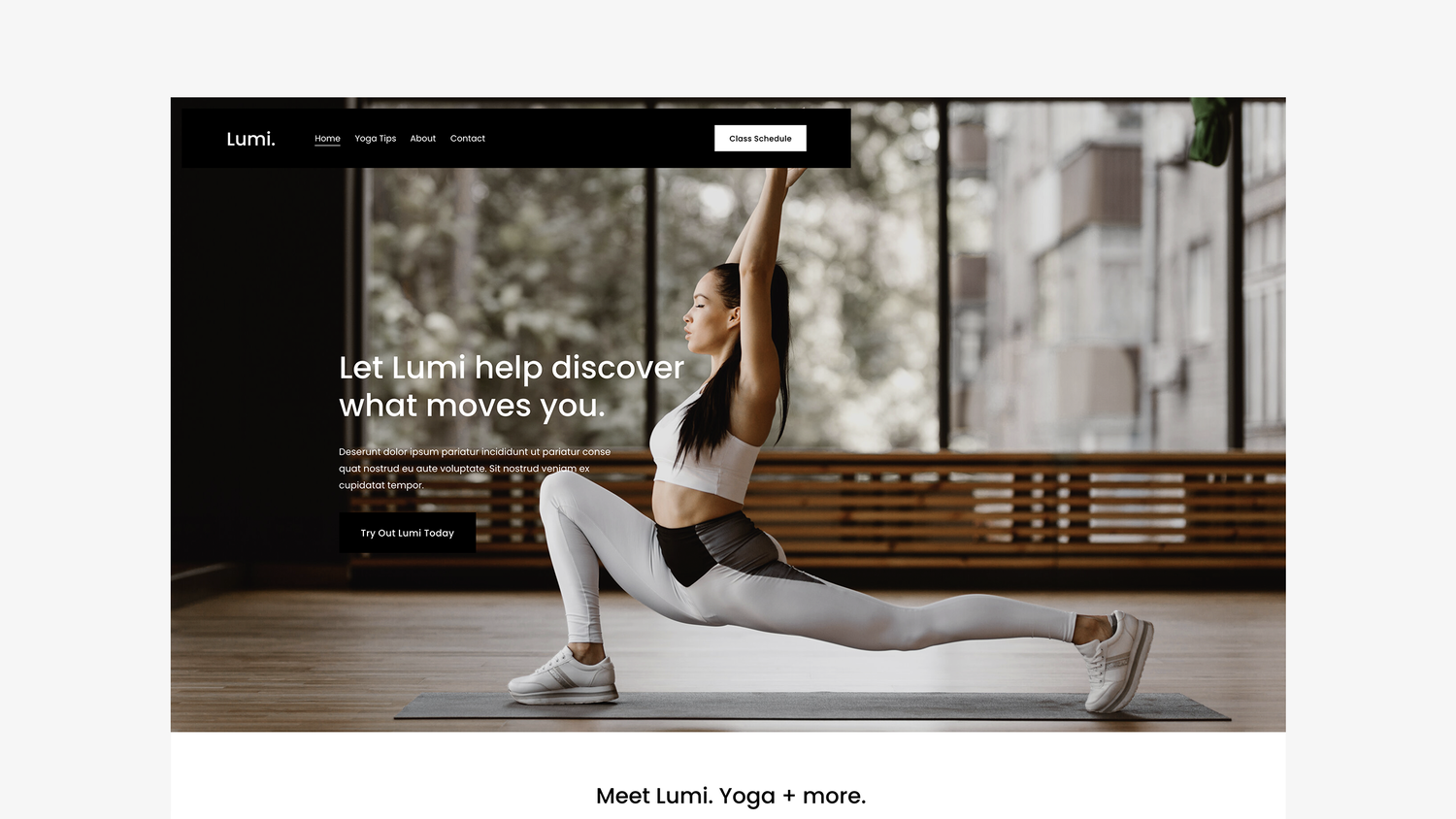
Lumi by Ghost Plugins
What I like:
This template is just so slick and cool! It is clean but still has a little edge. The floating header navigation can help keep your main links front and center (literally) but you could always disable that and keep it static if it wasn’t for you. I love the icons and features list on the home page and then all the really bold sections down below. Ghost always delivers on an awesome footer and this template is no exception - the newsletter box and links are such valuable real estate!
What I would add/change:
The demo content is set up to take advantage of a Squarespace Scheduling integration (which can be a great eCommerce tool) but if that doesn’t fit with your business, you could easily swap in membership areas, links to subscription products or boxes, or even shop categories! Also, even though I’m a fan of the black and white I wouldn’t be afraid to make this more fun, playful or bold by changing up the color palette in the site styles section. It’s so easy to update everything in just a few clicks!
Save 10% off any Ghost template with discount code: KRISTINENEIL

Web Design Trend: The Mega Footer
First impressions are everything and a mega footer allows you to have all the links you want on your site without compromising on a clean, minimal header. Find out why this design feature works and what to include in the footer of your eCommerce website.
Trends come and go, but some website design elements stand the test of time for good reason. Mega menus packed with images, links and features were all the rage for years. However, these cluttered menus can easily overwhelm visitors, especially on an eCommerce site. Luckily, there’s a better solution that helps make a great first impression while still providing easy access to important site content: the mega footer. By keeping your header clean and focused, you capture visitors’ attention right away. Then the mega footer at the bottom of each page conveniently houses secondary info, links and features exactly when site visitors need them. Read on to learn why mega footers work so well for eCommerce sites and what to include in your own mega footer.
For years, “mega menus” were all the rage. For anyone not up on their website developer lingo a mega menu is like a regular drop-down menu on steroids. Instead of just containing a simple column of links, a mega menu might also include images, span multiple columns, or even fill up the whole page. Here’s an example of mega menus in action on Crate & Barrel’s site:

Now I love me some C&B but this site has ALOT going on “above the fold” - or before you even scroll down on the site. And I would argue that most businesses aren’t going to be able to get away with having this amount of content or this many CTAs without losing people. We’re bordering on way too cluttered! It’s hard to know where to look or what to do first!
Luckily, there’s a solution that allows you to make a nice first impression and still get all those links out there for people: the MEGA FOOTER. To get a better idea of what I’m talking about here check out the bottom of Squarespace’s site:

All of those links would make the top of a page look CRAZY but make perfect sense in the footer. And by keeping the header simple, the first impression can be super focused with just four main things: Products, Templates, Resources, and Get Started.
Why Do Mega Footers Work?
Website visitors spend much less time looking at the top of your site than you think they do so you have only a few precious seconds to capture their attention when they first land on a page. All of the info you have is important, it just may not be TOP OF THE PAGE important, you know what I mean?
Your top navigation (the links that appear at the top of every page) should really stay focused on your primary graphic + your primary CTA. Knowing that you have room in your footer for everything else can help you create a stronger first impression. I tend to think of the header needing to appeal to newbies or first-time visitors and the footer for everyone else. (More on that topic in this post about mapping user journeys on your eCommerce site!)
Mega footers aren’t even necessarily that new or trendy, but they’ve been around long enough and there are so many new eCommerce sites made every day that web users are used to (and expect!) to go to the bottom of the page for additional info. This is one of those cases where I think the more it’s been in use, the more acceptable it is for eCommerce. Providing people with the right info at the right time can help reassure customers thinking about making a purchase.
What should you put in your mega footer?
Ok, so I’ve convinced you to give a mega footer a try but you’re wondering what are some things that you can or should include? Here are a few ideas!
Links to all your shop categories (even if they are also in your header)
Links to secondary pages such as About and Contact
Links to your FAQ page plus any other pages where you talk specifically about returns, shipping, or other common inquiries
A signup form for new customers
Instagram feed
Links to other active social media accounts
Contact info such as your address, phone number, and/or hours
List of locations or divisions of your company, if they have dedicated pages
A search block
Legal info such as your privacy policy or terms & conditions
A website footer is also a great place to include a small version of your logo and even your tagline or mission statement! It’s a nice way to end each page and just another opportunity you have to create a cohesive, branded experience on your eCommerce site.

UX Tips for Every Phase of the eCommerce Journey
Explore specific ideas and recommendations to get the most out of the Squarespace tools available to you. Learn how to translate your customer’s needs to specific website content and design elements to improve user experience for every phase of the customer journey.
This is the second post in a 2-part series about how to create a user-focused eCommerce website. If you missed Part 1 where I show you how to quickly and easily identify information that your customers need to know and walk you through how to map it to the decision-making process you can check it out here. In this step, we pick up where we left off with some concrete ideas on translating your customer’s needs to specific website content and design elements to improve your eCommerce UX.
Understanding what customers need to know and when they need to know it will help you cater to people in each phase of the decision-making process so you’re not coming out guns blazing while people are still getting to know you or not providing the right CTAs when it comes time to close the deal.
More importantly, becoming super focused on the needs of your customers is your opportunity to stand apart from big box stores and mega online retailers who have to lump everyone into one mass, generic “buyer persona” and aren’t able to niche down and be as laser-focused or as personalized as you can be. This is your chance to really shine and make sure that your website has content and CTAs that cater to people in each phase of the decision-making process. As a reminder, these are the 4 phases of the decision-making process:
Awareness → Consideration → Decision → Post-Purchase
In this post, we’re picking up where we left off using the list of what my Fake Plant Co. customers need to know and when they need to know it. For a refresher, here’s the list we made using the activities from part one along with the phases I mapped them to:
What types of plants are available (Awareness)
Why our plants are better than the kind from their local big box store (Awareness)
How we ship plants without killing them (Consideration)
Where plants are grown and sourced (Consideration)
How to decide which plants are best for them (Consideration)
What we do to guarantee their happiness (Decision)
How to place an order and what happens next (Decision)
How to care for their plant purchases (Post-Purchase)
How they can subscribe or join our plant membership club (Post-Purchase)
Let’s jump into how I can translate this road map into specific content areas and website design elements for maximum impact on an eCommerce website!
Awareness
In this phase, people are just discovering your brand and trying to quickly determine whether you’re what they’re looking for. You usually only have a few seconds to capture someone’s attention and convince them to stay. Here are some website features you can incorporate that cater to people in this phase:
Make sure you have a clear and unique header area (the info that’s “above the fold”) to capture people’s attention visually.
Include a tagline or “brand bio” that tells people about your business in one simple phrase or sentence.
Include simple navigation that highlights the categories of your shop without a whole lot of other clutter or unnecessary links.
Add a bold CTA - either a button or an announcement bar - that links to content that addresses the biggest objection you need to overcome or the main action you want people to take when first landing on your website.
Example
For my Fake Plant Co. I mapped the following two pieces of content to this phase:
What types of plants are available
Why our plants are better than the kind from their local big box store
Here’s how I could address each of them with my site’s content and design:

Since I know that most people’s first question is really going to be why they should even care to buy from Fake Plant Co. versus just hitting up their local big box store I would address that head on in the header section above the fold. In this case, I added it to the copy along with a compelling tagline. Right away, it's made clear to visitors that Fake Plant Co. will provide them with more personalized service at lower prices than they could get somewhere else. That takes care of quickly answering a couple big objections right up front!
After that, I think people would be most interested in just getting an idea of what type of plants are available so I would make sure that the top navigation (the links at the top of every page) feature the shop categories.
Now, when someone new lands on the homepage I know that I’m giving them what they need to know without them having to do any scrolling or clicking which is great!
Consideration
In the Consideration phase, people already kind of have a gist of what you’re all about and are thinking more seriously about making a purchase. They may still have some lingering doubts or questions but they like what they’ve seen so far! Here’s how you can cater to them with your website content and layout:
Highlight features and selling points midway down your homepage.
Create a FAQ page and link to it in your website footer (the links that appear at the bottom of every page).
Create educational content to help people feel guided and supported in their purchase.
Example
For Fake Plant Co. I mapped the following three pieces of info to this phase:
How we ship plants without killing them
Where plants are grown and sourced
How to decide which plants are best for them
And here’s how I could incorporate those things into my site design:

On the homepage, I would turn the things I want people to know into an easily scannable list. It doesn’t take a lot of words to help people learn about the company or address concerns or objections. In this section that I would include about midway down my home page, I turn questions I know a lot of people have while considering a purchase into features. This section has fewer than 50 words but has a major impact in moving people towards making a purchase.

Another feature that I could incorporate that would help people who are still pondering a purchase is a section that provides access to a free PDF guide that covers all the types of plant that Fake Plant Co. sells and helps people identify good picks based on lighting conditions, care needs and whether the plants are safe around kids or pets. Not only does information like this help people feel confident about their purchase it’s also a great way to build an email list!
Decision
So you’ve introduced yourself and provided all the right info people need to think about making a purchase and guess what? You convinced them! You may think that once you get here that it’s as simple as slapping in an “add to cart” button and sailing right across the finish line. But your work (and the customer journey are just barely half over) so it’s not time to let off the gas.
Remember that it may not be until several sessions in before customers decide to make a purchase so you can’t count on them remembering how to pick up where they left off - you need to explicitly guide and show them!
With those things in mind, here are some ideas for this section:
Use product tags and categories to help people move around your shop.
Enable the shop category sidebar and breadcrumbs.
Enable the Squarespace related products feature.
Highlight any guarantees directly on product pages.
Bonus: Product Pages & Checkout
Luckily, Squarespace takes care of a lot of the hard work of creating a smooth checkout experience for us but there’s always room to personalize and optimize. Here are two posts that provide even more detail if you want to dive even deeper:
Example
I identified two things that I thought people really needed to know during the decision phase for Fake Plant Co.:
What we do to guarantee their happiness
How to place an order and what happens next
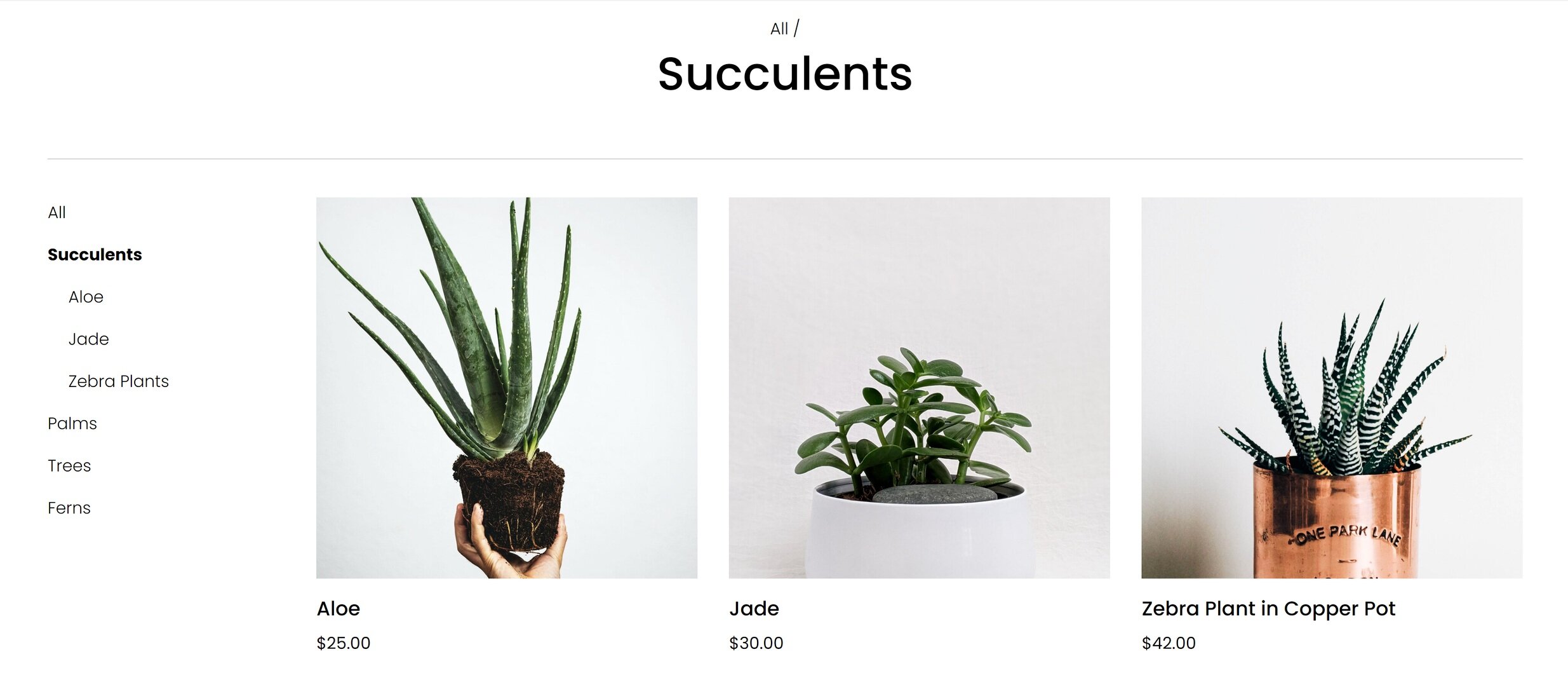
Since in this phase it’s important to make sure that people can easily find the products they are looking for, I would make sure that each of my products was assigned a category (and a subcategory, too, if that’s relevant). On Squarespace you can have up to three levels of nested categories to help people quickly find exactly what they’re looking for.

It can also be beneficial to repeat any brand promises that you may have made early on in the customer journey right on the product page where customers can see them without having to click away. Because I think that some people may still be a bit nervous about buying plants online, I referenced Fake Plant Co’s “Plant Happiness Guarantee™” right in the product description. I obviously would have detailed this elsewhere on the site (home page, FAQ page) but just referencing it here would be a good reminder to shoppers that their satisfaction is important to Fake Plant Co.
Post-Purchase
Depending on who you ask, it can be up to 25x cheaper to retain an existing customer than to acquire a new one. Knowing this, I always wonder why small eCommerce businesses with presumably limited marketing budgets seem more concerned about new customer acquisition than finding ways to build better relationships with past and existing customers ¯\_(ツ)_/¯ That’s a mystery we’re going to have to solve another day!
In the meantime, here’s how you can make sure your customers don’t fall off the map post-purchase:
Enable the option to sign up for email newsletters at checkout.
Send regular email communications out. (Bonus: use customer profiles to cater communications just to those who’ve purchased in the past to really personalize the experience!)
Provide options via tools like Member Areas or Squarespace Scheduling to create an ongoing relationship with past customers.
Example
Here are some opportunities I identified for Fake Plant Co. to connect with customers after their purchase:
How to care for their plant purchases
How they can subscribe or join our plant membership club

Since I already have all my customer’s data right inside Squarespace, sending super targeted post-purchase emails to customers using Squarespace Campaigns would be a no-brainer. Big companies rarely follow up on purchases in such a personalized way so it’s a great opportunity to use the tools at your disposal to easily connect in a meaningful way.

I think some of the most successful small businesses think beyond simple eCommerce transactions and consider ways to build lasting relationships with their customers. Fake Plant Co. could leverage Squarespace’s membership areas technology to provide super-personalized service with a side of bonus recurring revenue! Win-win!
Bottom Line
Carving out areas on your website that cater to customers on each phase of their journey isn’t just smart web design - it’s absolutely necessary to be competitive online. Small and medium businesses are rarely able to compete with Amazon or Walmart when it comes to price, fulfillment capabilities, or purchasing power. But they (and you!) have so many opportunities to connect with customers on a much deeper and more personal level.
Stop thinking about what you sell as a mere commodity and start thinking about the opportunities you have to create an experience for your customers that no one else can replicate. After all, being super focused on your niche is really the best UX tip!

How to Map Your eCommerce Customer Journey in 2 Simple Steps
Learn how to map your customer’s journey from discovery to purchase and beyond by answering 2 simple questions. This post features a series of guided activities to help you identify copy or design holes on your website so that you can create a compelling eCommerce experience that’s perfectly tailored to your niche audience.
This is the first post in a 2-part series about how to create a user-focused eCommerce website. In this step, I’ll show you how to quickly and easily identify information that your customers need to know and walk you through how to map it to the decision-making process. In part 2, we take things a step further and I’ll show you some concrete ideas on translating your customer’s needs to specific website content and design elements to improve your eCommerce UX.
I hear from a lot of small to medium business owners who just seem worried sick about how to compete with Amazon and other large retailers. The truth is that if you think you’re going to be able to compete with them and win when it comes to price or fulfillment or purchasing power, you’re wrong.
But all is not lost. Especially if you stop thinking about what you sell as a mere commodity and start thinking about the advantages you have to create an experience that the big guys simply can’t. The experience you create for your customers is the je ne sais quoi, the secret sauce that you offer that no one else can replicate.
Cultivating an exceptional user experience begins by understanding the path that customers take from discovering you to becoming lifelong fans. From there we can use what we’ve learned to create a user-focused eCommerce website that caters to different customer segments at each stage in their journey.
How To Map Your User’s Journey in 2 Simple Steps
If the phrase “user journey” kind of makes you want to roll your eyes because it seems super contrived and too much like marketer-speak, I don’t blame you. But it doesn’t have to be complicated! In my post about designing an effective home page, I actually gave you a quick way to be able to identify where customers are at on their user journey - even if I didn’t use that precise phrase.
So here it is. The only two questions you need to ask yourself to be able to understand your customer’s path from A -> Z:
What do customers need to know?
When do they need to know it?
That’s it. Your answers to these two simple questions will help you write better content, create a more engaging website, attract more customers and make more sales.
Activity
Get out a piece of paper or open up a blank doc. Make a list of what people need to know about your products and services. Don’t worry yet about the when, just focus on the what. Here are some writing prompts to get you started:
What’s the biggest problem your products or services solve?
What do customers need to know about how to purchase or how things work?
What do they need to know about your company, your process, your people?
What information will help people feel more confident in buying from you?
Remember, this list shouldn’t focus on what you want customers to know. What matters is what they need to know. The goal is to cut things down to the most basic, elemental key points. Customers don’t need to know your life story. There’s also no need to make this list super long. In fact, I would say the shorter and more concise you can make it, the better.
Example
Here’s an example using a fake company that I just made up right now called Fake Plant Co. that sells (real) plants. These are the things that my customers might need to know:
What types of plants are available
Why our plants are better than the kind from their local big box store
How we ship plants without killing them
Where plants are grown and sourced
How to decide which plants are best for them
What we do to guarantee their happiness
How to place an order and what happens next
How to care for their plant purchases
How they can subscribe or join our plant membership club
The 3 Stages of Decision-Making
If you google “decision-making process” you will get 1,001 variations of this flow:
Awareness → Consideration → Decision → Post-Purchase
This really just boils down to that for every purchase we all make, we move through each of these four phases: learning about the company and/or products, thinking about buying, making the purchase, and then whatever happens after that.
Activity
Can you see how this flow looks in your business? Below are some questions to help you think about the path your customers take. Jot down notes if you find them helpful, otherwise, just think about your average customer’s experience.
Do people move through each decision-making phase quickly (hello, impulse buys!)... or are things more drawn out?
Think about all the touchpoints that people have with your brand and how they fit into this flow. Some examples:
Are people initially finding you on social media without much awareness at all about your brand?
Do you have a newsletter you send out to a growing list of regulars?
What percentage of your sales are from past customers or referrals?
For your unique business are there any additional phases you would add or changes you would make to the flow?
Putting It Together
So now you should have your list of what people need to know and you’ve thought about the decision-making process as it applies to your business. Putting the two together is super simple. We’re just going to take our “what they need to know” lists and decide which phase each item fits into best to cover the “when do they need to know it” question.
Example
I’m a spreadsheet type of person so if it was me I’d make two columns with my items from the first step of this exercise in the WHAT in the first column and WHEN in the second but you do you. I mean, sketch this out on a cocktail napkin if that’s what you have handy. For each piece of information, I decided where it should fit into the decision-making process.
What do they need to know?
When do they need to know it?
What types of plants are available
Awareness Phase
Why our plants are better than the kind from their local big box store
Awareness Phase
How we ship plants without killing them
Consideration Phase
Where plants are grown and sourced
Consideration Phase
How to decide which plants are best for them
Consideration Phase
What we do to guarantee their happiness
Decision Phase
How to place an order and what happens next
Decision Phase
How to care for their plant purchases
Post-Purchase Phase
How they can subscribe or join our plant membership club
Post-Purchase Phase
Note: I think it’s important to consider each item one-by-one because it forces you to really think about where each piece of information fits. For example, in the case of my Fake Plant Co. above, I first had “where plants are grown and sourced” classified in the “awareness” phase. However, the more I thought about it the more it seemed like something that people wouldn’t really need to know until they were more seriously considering a purchase. Initially, it makes more sense to focus on why customers should buy from an independent online plant seller versus a local big box store and give them an idea of the types of plants sold. Another way to think about it is that knowing where something is sourced doesn’t really matter if you don’t know what the thing is or why you should even consider buying it in the first place.
Activity
Take your list and map each item to a phase. Don’t worry about putting the items in order to start - just assign them a phase. You can come back when you’re all done and put them in order.
Keep in mind that for your products or services there may be no clear right or wrong answers; this can be a little bit of a chicken or egg game of just trying to pick which should come first. The best part of this is that you have complete control over things. As a small business, you’re able to be nimble and adapt quickly to customer behavior. This means that if down the road your analytics are telling you that some messaging might be off you can always revisit this list and see if there are some adjustments you can make to better connect with your audience.
Bottom Line
The end result of this exercise should be a road map that spells out a path for you to create a unique, user-focused eCommerce website. You should now be super clear with what customers need to know every step of the way and you have a checklist of sorts that can help you identify holes on your website that need to be filled.
If you need some ideas for website design elements and layouts I would recommend for each phase of the decision-making process, click here to check out part 2 of this post. It features mockups of an actual website so you can see how to turn your what/when list into a great eCommerce experience for your customers.

Built-In Features to Help You Sell on Squarespace
Squarespace has awesome built-in eCommerce features that make managing inventory, promoting products, and merchandising your online store easy and seamless - without the need (or expense) of added apps or plugins. Check out the latest to see what you can incorporate into your online store today!
Updated June 2021
When you’re ready to do some serious business on your website, the last thing you want to do is realize that you don’t have the tools you need to get the job done. I love that Squarespace offer so many ways to help you sell without the need to add extra plugins. Not only does this save you $$$ but you don’t have to worry about trying to string together a bunch of apps that may not play nice together. Even though there are so many built-in features to help you sell on Squarespace, my bet is you can find something new on this list that you could incorporate to help you convert more visitors into customers. Let’s dig in!

Related Products
Displaying related products allows visitors to find what they're looking for more easily and maybe even help them discover something new that they didn’t even know you had! The secret to displaying related products on Squarespace is just to make sure everything has a category or tag. From there, the related products section auto-populates based on your preferences; you can choose to display recently added products within the same category or tag, products with the highest available stock level, or just a random assortment of related products. You can even fine-tune what’s displayed on a product-by-product basis if you want even more control!

Product Waitlists
This feature is geared towards making sure you don't miss a sale if any of your items go out of stock but you could also easily hack this to build hype and collect email addresses for people interested in products that haven't even launched yet. So many possibilities! To be able to do pre-orders and gauge interest in out-of-stock items without any custom code or a plugin is 😍
Bulk Spreadsheet Editing
If you want to update all your product info there’s no need to go into each. individual. product. one. by. one. and update them - use a spreadsheet to make those edits in bulk! The ability to bulk edit things like prices, variants, categories, and inventory via spreadsheet makes managing your store on Squarespace super easy.

Limited Availability Labels
This one is simple but powerful. Showing people that stock is low creates a sense of urgency is a known purchasing motivator to potential buyers. You can enable this label for any physical or service product in your store. This would be a great feature to turn on to highlight the exclusivity of a service you offer or boost sales of a limited edition item in your shop. You have a ton of flexibility to edit exactly what this message says and looks like so that it can be 100% on-brand for you.
Customizable "Sold Out" Labels
Why is this so cool? Because it means you can use Squarespace to manage the inventory of things beyond physical products and use a customized "Sold Out" label to indicate that your class is fully booked or service is not accepting new clients at this time. Combine this with the Waitlists and Limited Availability features above and you have several very powerful and automated ways to show people what you offer, create a sense of urgency to buy, and collect info from those interested who may have missed their moment.
Product Variant Images
Show shoppers an image of exactly what they are looking for so there’s no need for them to use their imagination when it comes to your different product variations. This allows them to compare things like different colors, patterns, or bundles visually. It’s so nice to be able to click on an option and then see exactly what you’ll be getting. This is such an important way to build trust with your customers and reduce frustration, returns, or confusion. If you have products with simple or complex variations, I definitely recommend making sure you have a photo of each iteration!

Member Areas
Member Areas is a great Squarespace feature that allows you to turn virtually any content you have into gated content that members need to pay to gain access to. I dig into this more in this post but in short, this is a great way to sell classes, guides, workshops - and so much more! You can offer multiple membership tiers and everything is automated and self-managed all right within Squarespace.
Bottom Line
If you're selling on Squarespace, be sure you’re taking advantage of all these built-in features to help your store stand out and be as engaging as possible. Not only will they make sure that your customers have a great experience when browsing your site, but you also won’t have to worry about the pain (or the cost) of managing third-party plugins. Want to make sure you’re in on all my favorite high-functioning features? Check out this post!

Squarespace vs. Shopify: Which is Best for Small Business?
Whether you’re just getting started or are looking to make a switch and wondering whether to go with Squarespace or Shopify, this post lists all the major considerations I look at and compares specific features between the two website platforms.
The most popular question that pops up in my inbox is someone wondering whether to go with Squarespace or Shopify for their eCommerce website. The second most popular is how to connect the two which I describe here but then try to talk you out of doing here 😉 So I think it’s fair to say that I’m always willing to give each side its fair shot, present all the pros and cons, and then let you decide what you think is best for you. I mean I clearly have my favorite but that’s not this post.
One more little soapbox before we jump into the details on this subject is that you should definitely be looking at this from within the scope of your own business. It doesn’t matter what anyone else is using or doing. It doesn’t matter if your uncle’s best friend’s daughter’s neighbor who once had a semi-successful Etsy shop thinks you should use Shopify. Hell, it doesn’t even really matter if I think you should use Squarespace! At the end of the day, even if you want to try to be as hands-off as possible, you’re the one who will be spending the most time on your website both on the front end and back end) so aside from your customers, you’re going to be the #1 user. The point is: you have to love it and at least (somewhat) enjoy using it and that’s worth something.
Moving along, in this post, I’m going to break down the main considerations I look at when I’m trying to figure this question out with a client. Some of them have clear “right” answers and some are a little more subjective.
Considerations
What You Sell
This is always the first question I ask because it does a good job of letting me know at the highest level what the eCommerce needs will be. Do you sell mostly products or services? Do you need people to book things or make appointments? Are you offering memberships or subscriptions? Maybe you’re a mix of all the above? In the most general sense, I tend to give Shopify points for people selling very large volumes of strictly physical products but Squarespace points for everything else.
Something else that factors in is how complex or customizable your products are. Squarespace has the same capabilities as Shopify when it comes to setting up complex variants and can even do simple customizable products very well.
An example of the type of customizations I’m referring to would be if you ran a custom embroidery shop. If you just needed people to be able to enter their initials for a monogram on a product when they add it to their cart, I think Squarespace does that better than Shopify. However, if you needed the price to be variable based on what letters or how many letters were entered for the monogram, that may be a better fit for Shopify + a third-party plugin. All this being said, there are ways to solve this problem and stay on Squarespace just like there may be reasons why you wouldn’t want to go the Shopify + plugin route (i.e. cost). I’ve built shops with 10,000+ variants on Squarespace and others with 5 services on Shopify and both were right for those businesses despite initial impulse telling us it would be better the other way around!
Squarespace
10,000 products per store page (can have multiple pages if needed)
Each product can have up to 6 options and up to 250 variant combinations
You can sell physical, digital, service, and subscription products in addition to memberships, events, classes, and other scheduling-based products - all without any third-party apps.
Shopify
Technically you’re allowed an unlimited number of products but some restrictions kick in after 50,000 products
Each product can have up to 3 options and up to 100 variant combinations (more allowed with apps)
You can sell physical products. Other product types (such as subscriptions or digital products) all require a third-party app from the Shopify app store.
Access to large dropshipping network
Shipping & Fulfillment
Shipping has a way of either making it or breaking it for some online retailers. I don’t know why, it’s just a lot of merchants’ Achilles heel! Most of the time, I think it’s because they’re making things more complex than they need to be. You can check out this post on why I think you should keep it simple for yourself and your customers and just offer free shipping but if that’s not part of your strategy, it’s helpful to know the types of options you would like to offer. Flat rate or weight-based? Carrier calculated rates? Will most of your shipments be domestic or will some be international? Do you also offer local pickup or delivery… or are most of your items digital and don’t even require any shipping at all?
Squarespace
Free, flat rate or rate depending on weight shipping with any carrier you choose
Carrier calculated rates for FedEx, UPS, or USPS (US Only)
Ability to create shipping zones based on country, state/province, and zip/postal code (US & Canada)
Print & pay for shipping labels directly through Squarespace or a shipping extension
Third-party fulfillment options are possible by connecting to Shipwire or Fulfillment by Amazon through ShipStation
Mutli-origin shipping through a shipping extension allows for shipping from multiple locations
Print on Demand through Printful or Printique
Shopify
Carrier calculated rates for DHL, UPS or USPS (US) or Canada Post (Canada) via Shopify Shipping
Carrier calculated rates for FedEx if you have your own account with negotiated rates
Ability to create country-wide shipping zones. Shipping zones based on zip or postal code possible with a third-party app
Print & pay for shipping labels through Shopify Shipping or a third party extension from the app store
Custom third-party fulfillment options or Fulfillment by Amazon with an Amazon Seller Central account
Ability to activate multi-origin shipping if you need to track inventory across multiple locations
Print on Demand options through the app store
Content & Design
I often hear potential clients say that they love the look of Squarespace but feel like they need the function of Shopify. In reality, you shouldn’t need to sacrifice design for function or vice versa - both are super important! Just because you’re planning on running the next big thing in eCommerce does not mean that things like style and content don’t matter. In fact, completely the opposite is true. Content is an important way to help you build an engaging brand. You’re going to want the ability to create landing pages, sales pages, a blog, and any other great-looking easily and effectively.
Squarespace
All design layouts and features are available for all pages.
Customize any page using any product block.
Create galleries, custom forms, event calendars, and portfolio pages without the need for third-party plugins
All pages have tidy URLs. For example “example.com/about” or “example.com/landing-page”
Nearly limitless style capabilities on every single page element
Rich blogging and podcasting capabilities are built-in
Easy SEO features
Shopify
Home page content capabilities are dependant upon theme
Interior pages (anything besides the home page) are created within the Shopify admin and limited to customization via custom CSS/HTML
Pages don’t have tidy URLs. For example “example.com/pages/about” or “example.com/pages/landing-page”
Limited style capabilities, some dependant upon theme
Simple blogging capabilities; layout and style are dependent upon the theme
Simple SEO features, some more robust tasks require access to code
Cost & Payments
There are some small differences in plan costs on Squarespace and Shopify. For complete details on the various plans and their features, you can check out this post for Squarespace or this page for Shopify. It’s tough to compare apples-to-apples between Squarespace plans and Shopify plans because they don’t really break them up into similar tiers. So for comparison's sake, let’s just look at both of Squarespace’s Commerce plans (Basic & Advanced) and then Shopify Basic & Shopify. The other big thing to keep in mind is that many of the built-in features on Squarespace require paid apps on Shopify. Depending on what you need, paid Shopify apps can end up costing hundreds of dollars each month alone just to get features that are included on Squarespace such as custom forms, galleries, social media tools, product merchandising, and selling features, etc.
Squarespace
Basic Commerce
Access to everything except Abandoned Carts, some advanced shipping and discount features & Commerce APIs
Unlimited Contributor Accounts
0% Transaction Fees
$26/mo (paid annually)
Advanced Commerce
Access to all Squarespace features
Unlimited Contributor Accounts
0% Transaction Fees
$40/mo (paid annually)
Shopify
Shopify Basic
Access to all features except reports & some international settings
2 Staff Accounts
2.0% transaction fees if not using Shopify payments otherwise 2.9% + 30¢ USD
$29/mo
Shopify
Access to all features except advanced reports
5 Staff Accounts
1.0% transaction fees if not using Shopify payments otherwise 2.6% + 30¢ USD
$79/mo
Wildcards
Are you starting from scratch or revamping an existing site? All of the above being said, there are always some variables and subtle nuances that I take into account when advising a client on which platform or subscription is best for them. To me, the most important of those is: do you have an existing website? If so, are there specific features or functionalities that you feel like you’re missing on that platform that you think switching to a different platform would help with?
I think people often want to change just because they think they should, or someone else told them they should, or they think that switching is going to magically solve a business problem they’re having. In reality, there may not be a need to scrap what you’ve already built entirely and it could be a better option to stay where you’re at and work on optimizing instead of moving. Moving a website to a new platform can cause a short-term dip in SEO and if you’ve built a lot of brand authority where you’re at, that’s an additional factor worth considering.
There may also be updates to the platform you’re currently on that you’re just not taking full advantage of. For example, most Squarespace sites out there could stand to be updated to the new 7.1 platform from their current 7.0 versions which would instantly make things feel fresh and new and offer some advanced eCommerce options.
Does anyone ever really move from Shopify to Squarespace? The conversation is often framed as if Squarespace is the “starter” website and that after you find a little eCommerce success, you’re ready to “graduate” or move up to Shopify. And I’m just here to challenge this assumption!
Moves can go both ways and you should select a platform that meets your business needs and goals for the next 2-4 years, regardless of what they were in the past. And, yes, this can mean moving from Shopify to Squarespace. Why would you do this? Several reasons: you’re looking for more design options and control, you want to focus on blogging as part of your key marketing strategy or you want to trim extraneous costs associated with Shopify apps just to name a few! So, while it’s definitely more common for people on Squarespace to wonder if they should be moving to Shopify, I think the future of eCommerce makes the simple, streamlined design of Squarespace a top contender as well.

6 Steps to Creating an Effective Online Store
A successful website isn’t just about good design; it’s about how well it works, how well it sells, and how effective it is as a business tool. Whether you’re just getting ready to launch or are interested in improving your website and customer experience, these 6 simple steps will help you get things going in the right direction on your eCommerce Squarespace website.
A successful website isn’t just about good design; it’s about how well it works, how well it sells, and how effective it is as a business tool. Whether you’re just getting ready to launch or are interested in improving your website and customer experience, these 6 simple steps will help you get things going in the right direction and help you take your site from basic & blah to eCommerce mega-machine.
1. Manage Inventory in Squarespace
If you ask me, one of the first red flags I look for on a mismanaged eCommerce site is people selling physical products but marking the inventory as “unlimited.” Eek. I mean, what kind of crazy roller coaster chaotic world this must be! If you sell… pretty much anything… you have to know how much you have to sell. Heck, even events or some digital goods need “inventory” counts; you know how many seats you have to sell or how many downloads you need to break even.
For a lot of shops, managing inventory could be as simple as syncing a Google sheet up to Squarespace with a tool like Zapier.
If you want to go a step further, you could also check out one of Squarespace’s inventory extensions. (I review them all here.)
Be sure to also check out the Squarespace Commerce app which allows you to make inventory updates from your phone or tablet.
2. Add Product Categories & Tags
Product categories & tags are the backbones of a well-organized eCommerce site. Not only can you use these to help guide visitors to exactly what they’re looking for quickly, but they can also help you do cool things with your navigation - and a few other tricks (more on those below)!
For a deep dive into all the ins and outs of categories & tags check out this post: How to Use Product Categories & Tags in Squarespace
For more tips on how to keep things from getting out of control, check out the tips in this post.
3. Use Summary Blocks
Alright, I told you that categories & tags would help you do cool things and this is one of them! I think a lot of people see Squarespace Summary Blocks as great tools for pulling in an overview of posts from blogs or events but they’re also indispensable for displaying product groups on your home page - or even in blog posts, like below! You can use a summary block’s filter settings to display products from any category or with any tag. You can also use them to display only featured products. This is a great way to showcase things like bestsellers, new items, or sale items.
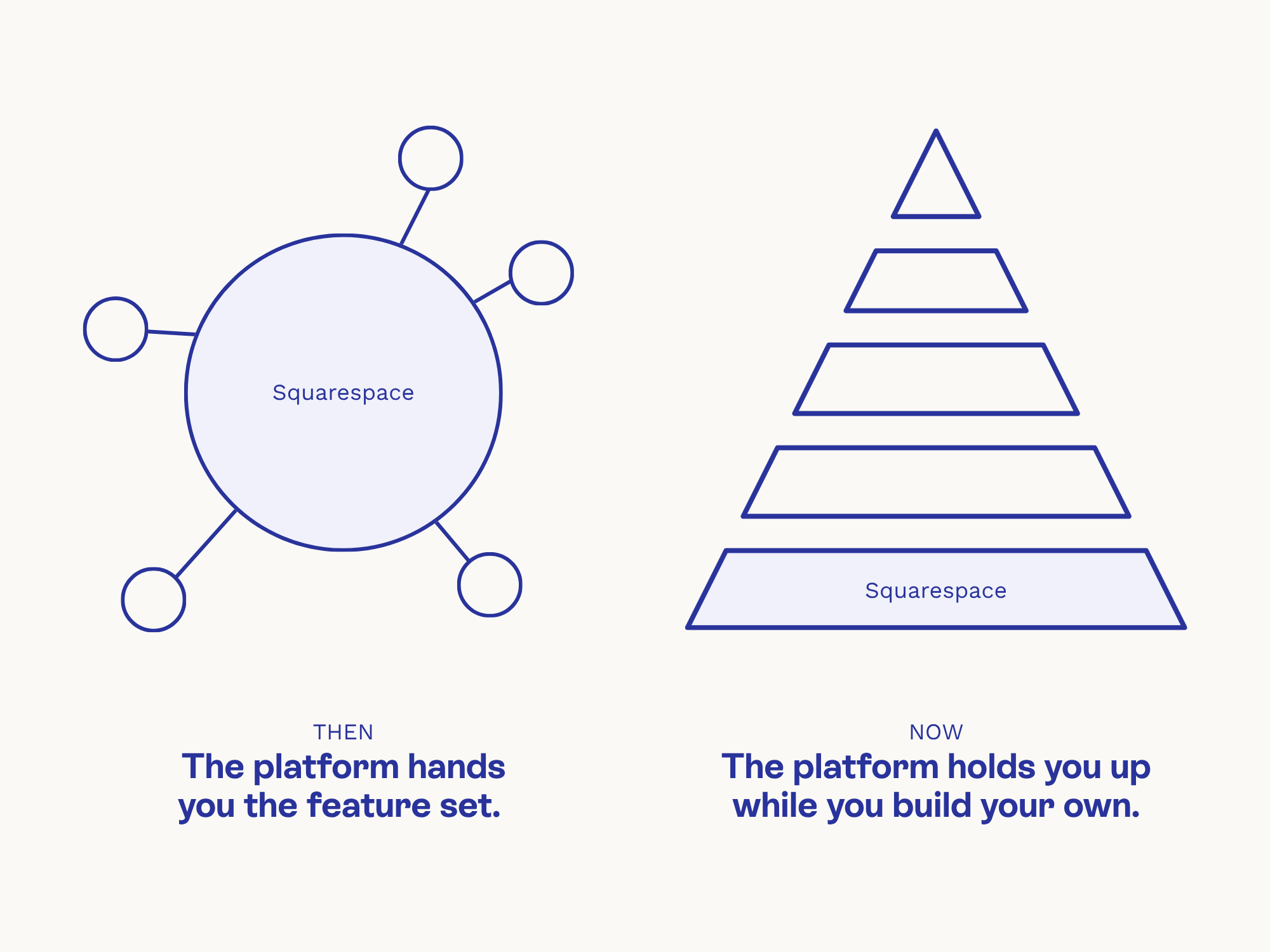
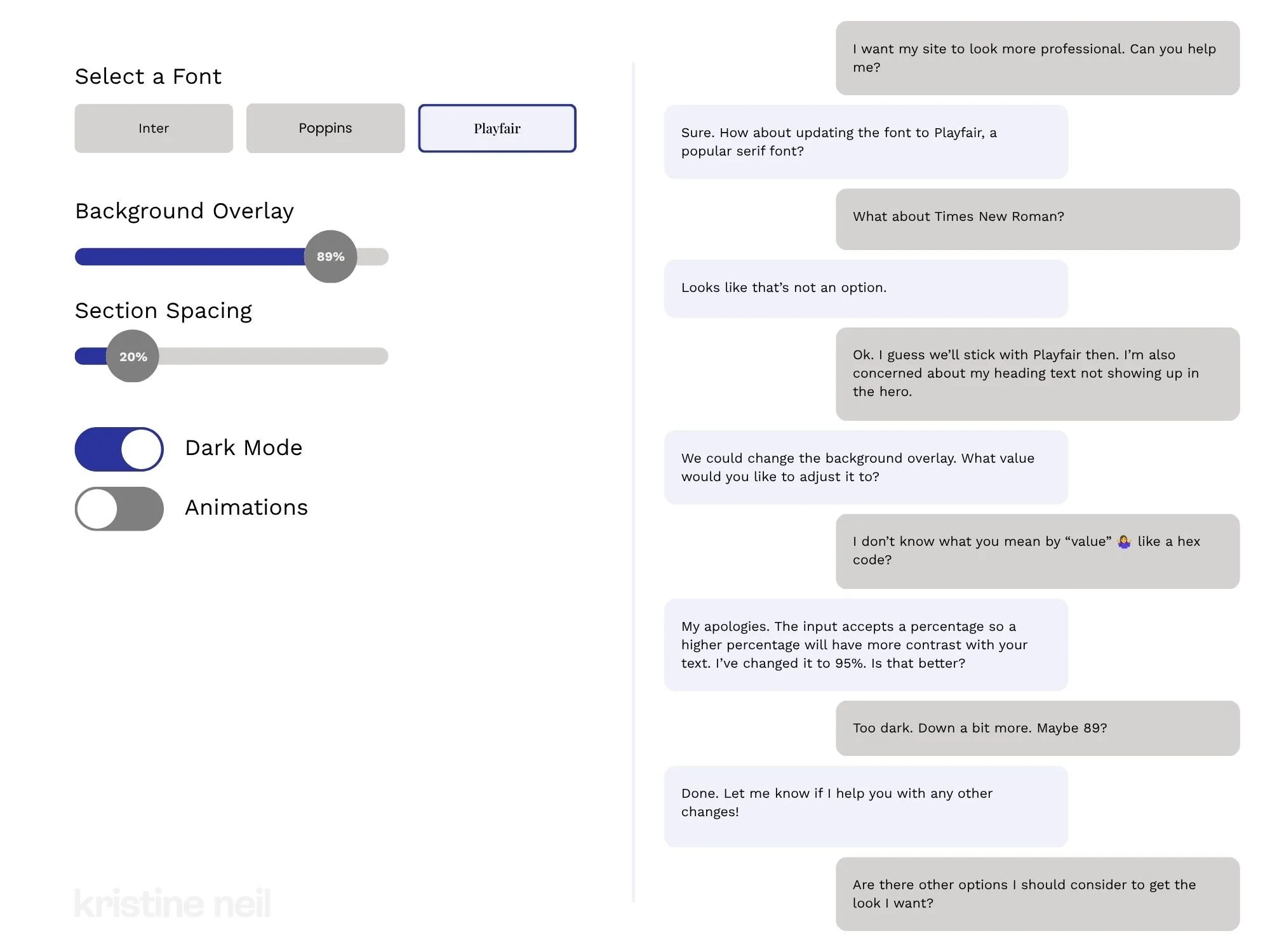

As an extension of this, you can also use product categories or tags to power some of my favorite Squarespace plugins like the Featured Product Tag and Product Shop Labels ones from this post.
4. Connect People to Your Email List
Beyond just sales, one of your goals really should be to always be growing your email list. It’s just such a valuable business asset! (And not just because you shouldn’t bank on social media.) I would definitely recommend asking people to sign up for your list at checkout in addition to offering a signup form in the footer of your site. Not sold on email yet? Let me convince you:
Email marketing offers a higher ROI than SEO, display, advertising, and other forms of digital marketing. It’s estimated that for every $1 you spend on email marketing, you can expect an average return of $42. More in this post.
According to another study, email marketing reigns supreme with an ROI of 4400%. No, that’s not a typo. More here: 4 Post-Sale Emails Every eCommerce Site Needs
Feeling stuck? Here are 11 Lead Magnet, Offer & Freebie Ideas to Grow Your Email List
5. Use Product Blocks
A Squarespace Product Block is like a summary block on steroids. But instead of giving you an overview of a bunch of different products in a certain category and inviting you to click through for details, a product block puts everything you need right there front and center. Product blocks turn any page you want into a shop page. Use them in blog posts, on event pages, on your home page, on landing pages - wherever they make sense for your business. Product blocks allow people to “add to cart” from right where they are, no need to navigate anywhere else.
If you’re creating targeted landing pages for paid ads or social media posts, use product blocks to add just the product you’re advertising right on the page. No distractions or other shop items to get confused by! For more on creating a great sales page, check out this post.
You could also use a product block as a way to create an interesting upsell or cross-sell layout by adding it to the additional info section of a core product. This would be a way to display super-targeted products as opposed to using the Related Products feature which is going to constantly auto-update.
6. Add Automatic Discounts
Look, I love a coupon code as much as the next person but you know what I love more than that? NOT having to remember a coupon code in order to score a deal. 🥳 Automatic discounts on Squarespace allow you to set the conditions that need to be met in order to get the discount. Once the criteria you define is met ( - boom - auto discount. This is a great way to improve the experience of shopping on your site for your customers. You can create automatic discounts that apply to any order, orders over a certain amount, single products or whole product categories!
For more on this check out this post: eCommerce Crash Course: Coupons, Offers, Discounts & Promos
If you need some ideas on some sales and offers to try out using automatic discounts check out this post.
Automatic discounts like this are separate from and in addition to any automatic free shipping offers you create. I would just keep this in mind so that you don’t create too many offers that people can stack together (just pick one or the other). Check out this post for more on free shipping and setting up a profitable shipping strategy.
Bottom Line
When it comes to creating an effective eCommerce site, you’ve got to focus on some of the little things that have a big impact on customer experience and your business. Whether it’s managing inventory effectively, properly merchandising your products, or ensuring every interaction your customer has is smooth and easy - you can do it all using the built-in tools on Squarespace.

Kristine Neil
Fractional Web Partner
I'm Kristine Neil - a communications strategist who has spent 20+ years designing websites, first running a full-scale design and marketing agency, and now leading my own studio. I've been the creative director managing the work, the coder quietly fixing what others couldn't, and the strategist in the room asking why before how. Somewhere between the MBA and the other degrees, I decided web design was just one tool in a much bigger toolbox - the real work is figuring out what you're trying to say, who needs to hear it, and what's getting in the way. A website is just where all of that comes to life.
I build on Squarespace, and after years deep in the platform I know how far it can go and when to push past its limits. These days, I'm especially drawn to working as a fractional partner - getting to know an organization over time and helping with whatever moves them forward, whether that's a full redesign, an ongoing hand with content and strategy, or just being the person who knows their site best. I write here about eCommerce, web strategy, and making the complex feel a little more human.
A grant-funded rebuild on Squarespace with live transit and parking data, WCAG 2.1 AA certification, and a site a team of 1.5 can run - for 51% less than what it replaced.