

Reimagining Squarespace
For years, when someone asked me why Squarespace, my answer was basically: because it comes with everything. The blocks. The built-in store. The blog. The gallery. The calendar. It was the whole kit and caboodle, and I loved that I could hand a client one login and say, here, this does all of it.
I pictured it like a hub. Squarespace in the middle, and everything a website needed radiating out from it. The center of the universe. One platform, one-size-fits-all, the be-all-end-all.
I don't see it that way anymore.
And it's not necessarily that Squarespace got worse (though we could argue about a few things). It's that what I want from it changed. Somewhere in the last couple of years - between the rise of what Lex Roman calls Cottage Code and the simple fact that anyone can now build a genuinely custom tool in an afternoon - the center-of-the-universe model just stopped making sense to me.
Because you know what they say about trying to be everything to everyone: you can't. Not really. So the blog is fine. And the store is fine. But "fine" is the ceiling when one platform is trying to cover every use case for every person on earth. And I'm not in the business of building just fine websites.
So I flipped the picture.
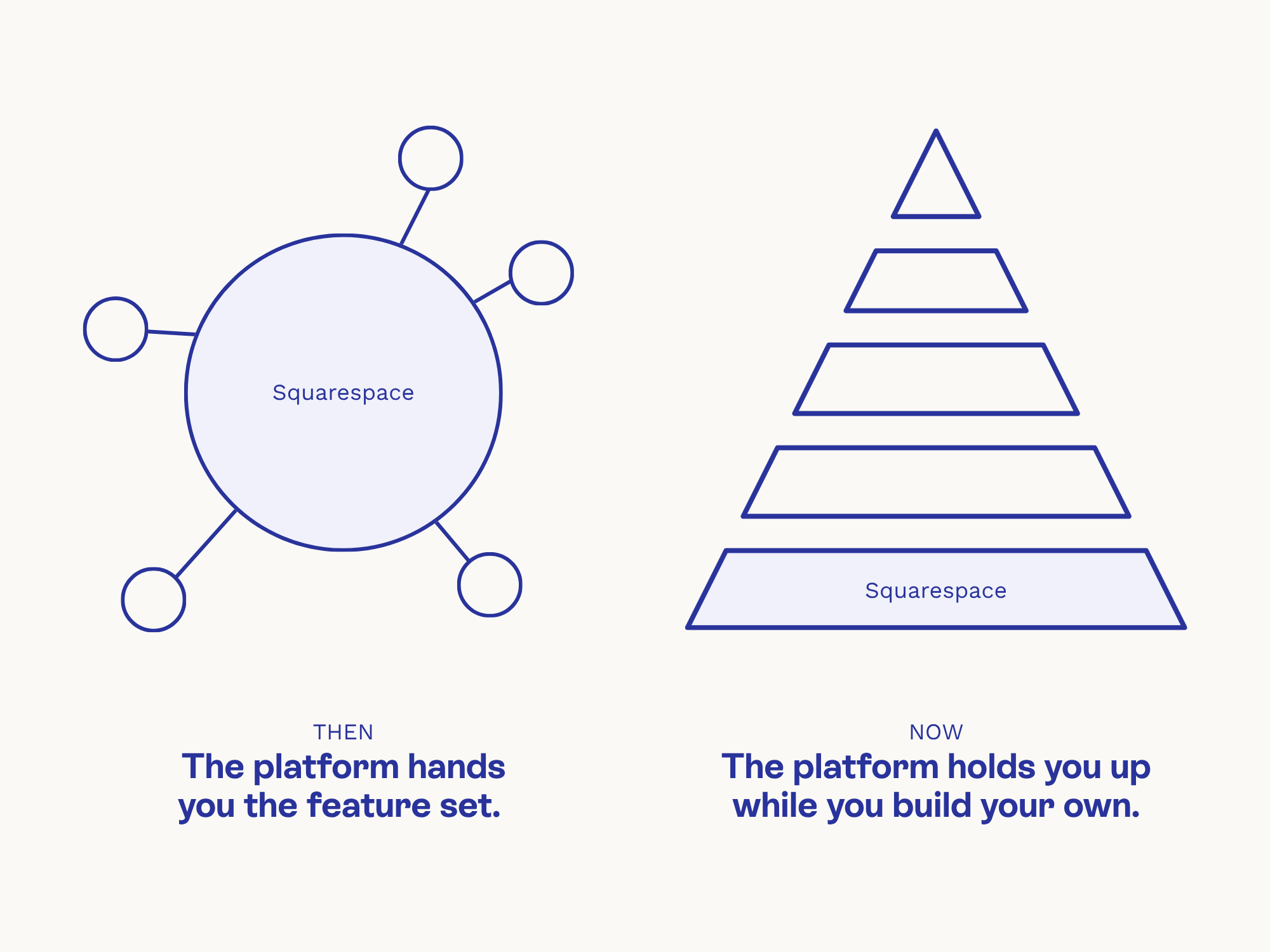
I don't want Squarespace in the center anymore. I want it on the bottom. The foundation. The frame, the wiring, the plumbing - the structural stuff that has to be up to code or the whole house falls down. And then I build exactly what I want on top of it.
Take the calendar. I genuinely do not care whether Squarespace's calendar block works the way I wish it would. I just need a page to exist - a real, live, secure page, with the markup and styling and schema already handled - and then I'll build the calendar I actually want right on top of it (hi, Eventually). Squarespace gives me the floor to stand on. I bring the furniture.
I think this is where web design is heading. Because as powerful as AI tools have become - and we absolutely should all be doing more Cottage Code™ - nobody actually needs to be building the basics from scratch. Nobody wants to hand-build SSL and security monitoring and proper page markup. That's not the fun part. That's the plumbing. So let Squarespace do the plumbing. Better yet, let it be the plumber you call at 3am when a pipe bursts.
It's earned the job. Squarespace was founded in 2003, which in internet years makes it downright ancient - no Facebook, no Twitter, not even any iPhones when it launched. Whole tech empires have risen and fallen while it just kept trucking along. And I don't know about you, but when I'm choosing what to build on, "has survived twenty years of internet chaos" counts for a whole heck of a lot.
I just don't need it to be the center of everything. I don't need its calendar block to work or its feature set to wow me. I need it to be stable, secure, easy to hand off to a client, and gloriously unremarkable in the best possible way - so that all the interesting, custom, weird, wonderful stuff gets to live on top.
