

Notes on building smarter websites for actual humans.
Reimagining Squarespace
I've started thinking about Squarespace differently - not just a place to build a site, but the foundation everything else stands on.
For years, when someone asked me why Squarespace, my answer was basically: because it comes with everything. The blocks. The built-in store. The blog. The gallery. The calendar. It was the whole kit and caboodle, and I loved that I could hand a client one login and say, here, this does all of it.
I pictured it like a hub. Squarespace in the middle, and everything a website needed radiating out from it. The center of the universe. One platform, one-size-fits-all, the be-all-end-all.
I don't see it that way anymore.
And it's not necessarily that Squarespace got worse (though we could argue about a few things). It's that what I want from it changed. Somewhere in the last couple of years - between the rise of what Lex Roman calls Cottage Code and the simple fact that anyone can now build a genuinely custom tool in an afternoon - the center-of-the-universe model just stopped making sense to me.
Because you know what they say about trying to be everything to everyone: you can't. Not really. So the blog is fine. And the store is fine. But "fine" is the ceiling when one platform is trying to cover every use case for every person on earth. And I'm not in the business of building just fine websites.
So I flipped the picture.
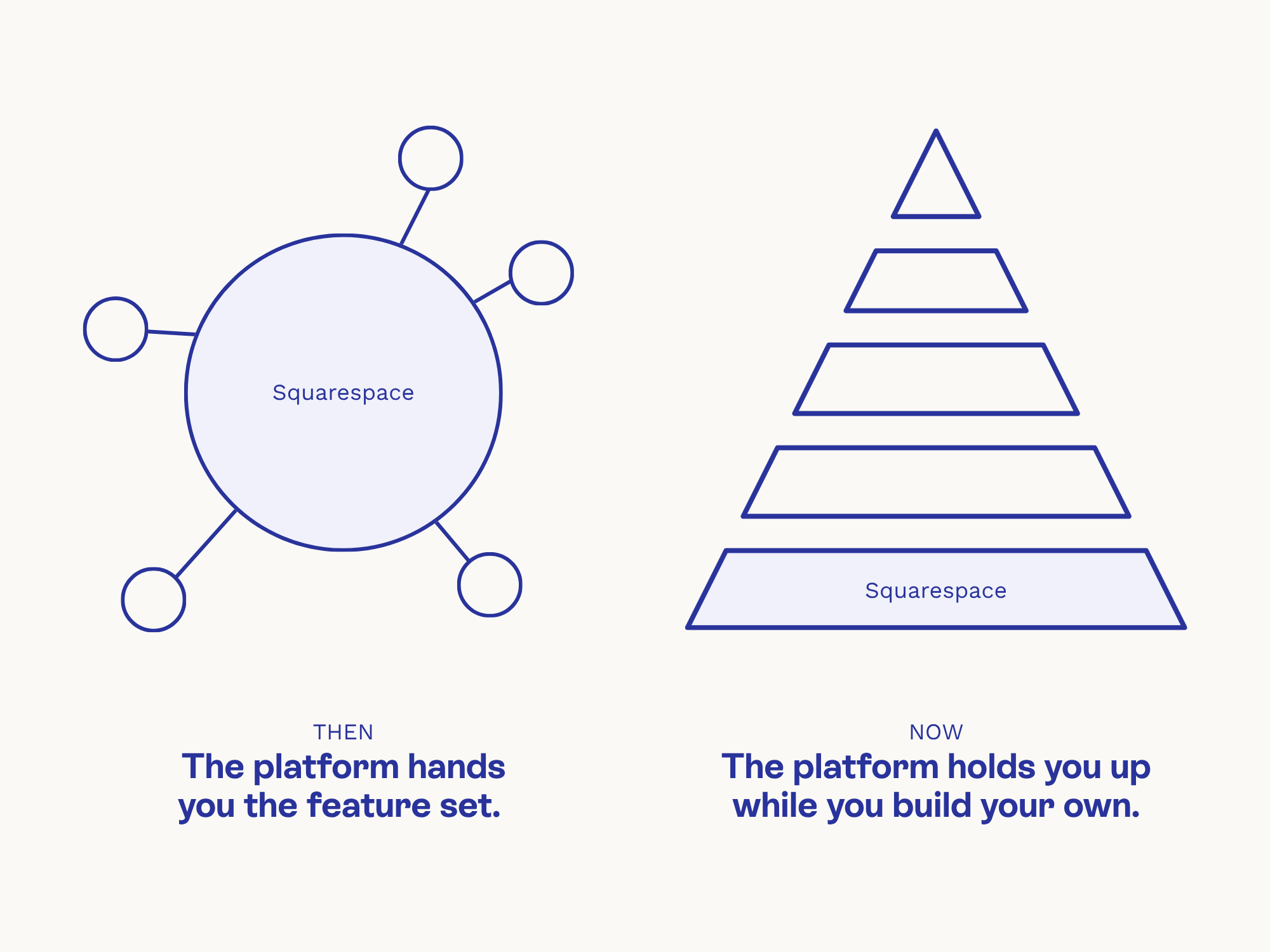
I don't want Squarespace in the center anymore. I want it on the bottom. The foundation. The frame, the wiring, the plumbing - the structural stuff that has to be up to code or the whole house falls down. And then I build exactly what I want on top of it.
Take the calendar. I genuinely do not care whether Squarespace's calendar block works the way I wish it would. I just need a page to exist - a real, live, secure page, with the markup and styling and schema already handled - and then I'll build the calendar I actually want right on top of it (hi, Eventually). Squarespace gives me the floor to stand on. I bring the furniture.
I think this is where web design is heading. Because as powerful as AI tools have become - and we absolutely should all be doing more Cottage Code™ - nobody actually needs to be building the basics from scratch. Nobody wants to hand-build SSL and security monitoring and proper page markup. That's not the fun part. That's the plumbing. So let Squarespace do the plumbing. Better yet, let it be the plumber you call at 3am when a pipe bursts.
It's earned the job. Squarespace was founded in 2003, which in internet years makes it downright ancient - no Facebook, no Twitter, not even any iPhones when it launched. Whole tech empires have risen and fallen while it just kept trucking along. And I don't know about you, but when I'm choosing what to build on, "has survived twenty years of internet chaos" counts for a whole heck of a lot.
I just don't need it to be the center of everything. I don't need its calendar block to work or its feature set to wow me. I need it to be stable, secure, easy to hand off to a client, and gloriously unremarkable in the best possible way - so that all the interesting, custom, weird, wonderful stuff gets to live on top.
Even the tomatoes need a website.
I started a garden this spring, mostly as a rebellion against the internet. Turns out even a raised bed of heirloom tomatoes couldn't get me to quit thinking about websites.
I've joked with my professional colleagues more than a few times this past year that it feels like, in a lot of ways, we're moving backwards. For twenty-plus years we've been pushing everything forward - online directories replaced phone books, QR codes replaced printed menus, websites replaced (or at least tried to replicate, in their own clunky way) the experience of walking into an actual shop. And now here we are, watching some of that swing back the other direction. Funny how that works.
I don't think it's a coincidence that this is happening right as AI floods every feed with content that reads like it was written by anyone, for anyone - and therefore by nobody, for nobody. When anyone can generate a course, a newsletter, a "here are 5 tips" post in about four seconds flat, the stuff that can't be generated starts to feel valuable again. A conversation. A person who actually shows up. A booth at the farmers market.
I've felt this pull myself, more than I'd like to admit. The more digital everything gets, the more I find myself craving things that are stubbornly, inconveniently analog. So much so that I've genuinely wondered lately whether what I do - which is design digital experiences for a living - is still relevant, or if I should just give it all up and go be a farmer instead.
This existential crisis was so real that I did the unthinkable earlier this spring: I started a garden.
I want to be clear that I am not a gardener. I am, very generously, a novice, extremely first-year, please-don't-die-on-me-now gardener. A black thumb. But something got into me and now I've got heirloom tomatoes and peppers going in the backyard, and I check on them about as often as I check Slack, which is to say, quite a lot.
Here's the part that actually got me, though, and the reason I'm writing this and not just posting tomato pictures. I was out there the other day, hands in the dirt, feeling pretty smug about my little rebellion against the algorithm, when I caught myself thinking: you know, if I ever actually sold these, like, say at a farmers market, I'd totally make myself a cute little tomato website.
Not because I'd need one to look official. Because I'd want people to know which Saturday I'd actually be at the market. I'd want a way to text the neighbors when a new batch of peppers came in. I'd want the people who missed me that week to still be able to grab a box. None of that has anything to do with looking legit online - it's just logistics. Even the most physical, dirt-under-your-nails business in the world still needs a digital way to say here's where I am and here's how to get some.
Even out there, doing the most analog, unplugged, back-to-the-land thing I could think of. My brain still drifted to the internet.
Because - surprise! - even the tomatoes need a website 🍅
I didn’t sign up to be a content creator.
I took a break I didn't explain. You don't really owe anyone a reason for that - but this time I think I owe you one, because there's a good chance you've been feeling some of it too. So here's where I went, and the promise I'm bringing back with me.
You may have noticed I went quiet.
The blog. The newsletter. Content of any kind, really. And look - I think we’re all allowed to take a break for any reason, or no reason, without filing a report about it. But this time I feel like I owe you one, dear reader. Because there's a decent chance you've been feeling some of what I've been feeling too.
So, here's the truth: the idea of being a "content creator" in 2026 temporarily froze me solid. I kept ruminating on the same questions. Am I just making fodder for the bots to scrape, remix, and spit back out? Is there still a place for me? Where do I fit? And, when every answer seems to be one prompt away, is it worth spending the finite energy I've got to add one more voice to the noise?
And it is a lot of noise, isn't it? There's just so. much. information.
Because somewhere along the line - no matter your job or industry or expertise - we all got handed a second job: content creator. Write the post. Record the thing. Publish every thought you've ever had. Feed the SEO machine and pray it eventually connects you to someone willing to pay you to do the work you actually wanted to do in the first place.
I've been writing about web design, technology, marketing, branding, PR - all of it - for over 15 years. Published in the usual suspects: Forbes, Business Insider, the lot. And in that time I've watched wave after wave of people announce that something was finally, definitely dead.
Blogging was dead.
Newsletters were dead.
Social was dead.
Courses were dead.
On and on.
Most of those waves were easy enough to ride out. Courses weren't dead, because people want to learn from people. Newsletters weren’t dead, because nobody fully trusts the algorithm. Blogging wasn't dead, because Google still cared. Social wasn't dead, because it’s just so damn easy.
But AI hasn't been a wave.
It started gentle enough. And then, before I'd really clocked what was happening, I was out past where I could touch and the current had me.
That’s the things about a rip tide - it doesn't announce itself.
It just quietly carries you out.
It felt like if I wasn't trying every new tool, I was falling behind. And if I was trying them, I was... cheating? And then the whole thing sped up into a fire hose - sorry, I'm mixing my water disasters, but that's honestly how it felt. Pulled under and hosed down at the same time.
And I'll confess - there were posts where I phoned it in. (I'll let you guess which ones.)
I let AI plan the calendar, and then help a little too much with filling in the blanks. It's not that I wasn't there. I was. It was still my writing - just sterilized. My ideas - turned down to about a 7.
Me, on mute.
There was a second reason I went quiet, too, and it's a bigger one than I can do justice to here. It has to do with eCommerce - specifically eCommerce on Squarespace - and some feelings I couldn't ignore anymore about helping people sell things I don't believe in. I'm not done with any of it. But my views have genuinely shifted, and that deserves its own post, not a paragraph I rush through on my way out the door. So I'm leaving it there for now. More soon. I mean it this time.
So here we are. I'm back. No plan - and honestly, that's the point. The calendar, the schedule, the forced output - that's the force that muted me in the first place. So I'm not rebuilding it. I'll write when I have something I actually want to say.
And here's the part I want to be honest about, because I'd rather tell you the truth than make a promise I'd have to weasel out of in six months. I'm a technologist. I poke at all of it. You will not catch me pretending I don't use these tools - I do, and I plan on sharing about it honestly when I do. I’m looking for ways that AI can enhance my work, not replace me in it.
But the line is this: the words are mine. The thinking is mine. When you read me, you're getting me at full volume - not the muted, sterilized, turned-down-to-a-7 version. I'm not even running this shit through Grammarly. My writing isn't perfect. I make mistakes, my grammar gets loosey goosey, my old AP English teacher would scoff. Good. That's how you'll know it's me and not a very confident bot doing an impression of me.
One more bit of honesty while we're here. I'm leaving all the old posts up. Every one. A lot of them are tutorials people still search for, and plenty are ideas that, frankly, hold up just fine. Others are outdated, or my views have shifted since, and I could quietly make those disappear - but dirty deletes aren't my style. So instead I'm tagging the old stuff as "From the Archive." That's not me telling you it's wrong or useless. It just means it's from the before times.
And underneath all of it, still, is the web.
It sounds cheesy, but I still believe in this space as a genuinely beautiful way for people to communicate. I've designed brands and I've designed for print. I've crafted messaging for huge political campaigns and dialed in marketing strategy for tiny businesses. The heart of every one of those was the people behind the work, the humans, and the digital face of it was always, always a website.
Here's the thing about a rip tide. You don't beat it by thrashing straight back toward shore - that's how people drown. You swim sideways until it lets go, and then you find your own way in. That's about where the last stretch has left me. I stopped fighting the current head-on. I'm swimming sideways.
Thanks for riding it out with me. I can't wait to show you what's on the other side.
Kristine Neil
Fractional Web Partner
I'm Kristine Neil - a communications strategist who has spent 20+ years designing websites, first running a full-scale design and marketing agency, and now leading my own studio. I've been the creative director managing the work, the coder quietly fixing what others couldn't, and the strategist in the room asking why before how. Somewhere between the MBA and the other degrees, I decided web design was just one tool in a much bigger toolbox - the real work is figuring out what you're trying to say, who needs to hear it, and what's getting in the way. A website is just where all of that comes to life.
I build on Squarespace, and after years deep in the platform I know how far it can go and when to push past its limits. These days, I'm especially drawn to working as a fractional partner - getting to know an organization over time and helping with whatever moves them forward, whether that's a full redesign, an ongoing hand with content and strategy, or just being the person who knows their site best. I write here about eCommerce, web strategy, and making the complex feel a little more human.