

Notes on building smarter websites for actual humans.
In defense of the knob.
Everyone's racing to replace buttons and sliders with a blank chat box. Here's why that's a downgrade - and why some friction is actually information.
I had to rent a car recently, one of those with basically no buttons or knobs anywhere. Everything lived in a touch screen. There was no way to turn the volume up while zooming down the freeway without looking at a screen, no tactile knob to crank the AC, no button to tell it I wanted the radio without swiping through three menus while dodging traffic. It was horrible and I hated it.
I don't know who decided that every interface in a car should be touch-based, but here's the thing about a physical knob or a toggle: you can build muscle memory around it. You can operate it safely while also operating a moving vehicle. There's feedback - a click, a resistance, a little bump under your thumb - that tells you the thing you meant to do got done. You can feel it. A touch screen can't come close to replicating that, especially not safely at (or above?) the speed limit.
Anyways, somewhere around mile forty of white-knuckling that touch screen, it hit me: we're doing the exact same thing to the web right now. We've decided, collectively and kind of suddenly, that all friction is the enemy. That the ideal interface is no interface at all - just a blank box where you type what you want and it appears. And look, sometimes that's magic. But we've badly overcorrected, because sometimes friction is information.
Now, you might be thinking it's great that I design websites and not cars, which, fair. But sit down and buckle up, because my obsession with the analog doesn't stop at vehicle design. Let me introduce you to my love of a digital knob, button, or toggle.
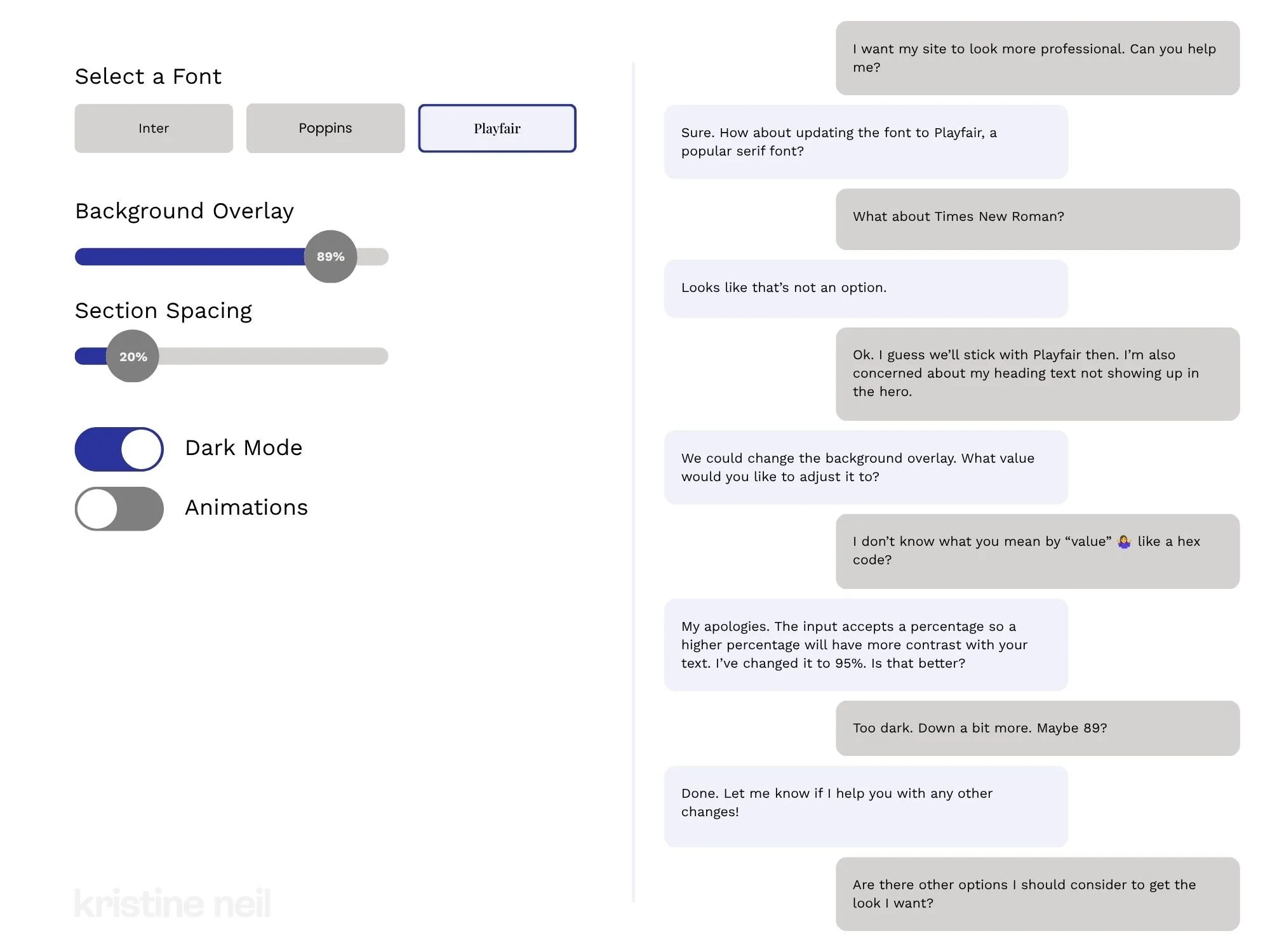
On the left, all options are surfaced and clear. On the right, well, let’s hope you know what you’re asking for.
Take something small and simple, like changing a few settings on a website. On a real dashboard, every option is sitting there in front of you. You pick a font by looking at it. You drag a slider until it looks right. You flip a toggle and watch the thing change. You didn't have to know the name of anything. You didn't have to know the font was even an option - you just saw it and grabbed it. A few seconds and you're done.
Now do that same thing in a chat window. Suddenly none of it is visible. You have to already know what you want to change, what it's called, and roughly what value you're after - and then describe all of that clearly enough for something on the other end to act on it. You wanted to nudge the overlay a little darker and now you're being asked for "a value" and you're sitting there going... a hex code? A percentage? What are my options? You can't rule things in or out because you can't see anything to rule out.
And this is the part people miss. Because the chat still has friction - not from the assistant being dumb, but from the medium itself. A dashboard lets you work by seeing and doing. Chat makes you work by knowing and describing. And describing a feeling or even a thought or idea is genuinely hard, way harder than dragging a slider until your eyes go "there, stop." You cannot choose from options you cannot see. You simply don't know what you don't know.
This is the whole trick of a good control, digital or otherwise. It doesn't just do the thing. It shows you the thing exists, shows you the range, shows you where you are in that range, and gives you something to push against. A good dashboard tells you at a glance that the fan's already on high and the station's set to 94.7 - you know your whole situation before you touch anything. The blank chat box does none of that. It doesn't tell you the fan is on high because it doesn't even tell you there is a fan.
I'm looking forward to seeing more people skip the trend of everything needing a chat bot, a blinking cursor in a blank box. Because what we need instead is clearer information. And sometimes that's best done with a toggle, a button, a dropdown, a slider. I've spent enough time jabbing at a touch screen at freeway speeds to know some things are just better with a knob.
Additional read I found a couple months after writing the above: Nobody wants a blank page. Nobody touches a perfect one. “The empty field reads as a demand rather than an invitation.”
Even the tomatoes need a website.
I started a garden this spring, mostly as a rebellion against the internet. Turns out even a raised bed of heirloom tomatoes couldn't get me to quit thinking about websites.
I've joked with my professional colleagues more than a few times this past year that it feels like, in a lot of ways, we're moving backwards. For twenty-plus years we've been pushing everything forward - online directories replaced phone books, QR codes replaced printed menus, websites replaced (or at least tried to replicate, in their own clunky way) the experience of walking into an actual shop. And now here we are, watching some of that swing back the other direction. Funny how that works.
I don't think it's a coincidence that this is happening right as AI floods every feed with content that reads like it was written by anyone, for anyone - and therefore by nobody, for nobody. When anyone can generate a course, a newsletter, a "here are 5 tips" post in about four seconds flat, the stuff that can't be generated starts to feel valuable again. A conversation. A person who actually shows up. A booth at the farmers market.
I've felt this pull myself, more than I'd like to admit. The more digital everything gets, the more I find myself craving things that are stubbornly, inconveniently analog. So much so that I've genuinely wondered lately whether what I do - which is design digital experiences for a living - is still relevant, or if I should just give it all up and go be a farmer instead.
This existential crisis was so real that I did the unthinkable earlier this spring: I started a garden.
I want to be clear that I am not a gardener. I am, very generously, a novice, extremely first-year, please-don't-die-on-me-now gardener. A black thumb. But something got into me and now I've got heirloom tomatoes and peppers going in the backyard, and I check on them about as often as I check Slack, which is to say, quite a lot.
Here's the part that actually got me, though, and the reason I'm writing this and not just posting tomato pictures. I was out there the other day, hands in the dirt, feeling pretty smug about my little rebellion against the algorithm, when I caught myself thinking: you know, if I ever actually sold these, like, say at a farmers market, I'd totally make myself a cute little tomato website.
Not because I'd need one to look official. Because I'd want people to know which Saturday I'd actually be at the market. I'd want a way to text the neighbors when a new batch of peppers came in. I'd want the people who missed me that week to still be able to grab a box. None of that has anything to do with looking legit online - it's just logistics. Even the most physical, dirt-under-your-nails business in the world still needs a digital way to say here's where I am and here's how to get some.
Even out there, doing the most analog, unplugged, back-to-the-land thing I could think of. My brain still drifted to the internet.
Because - surprise! - even the tomatoes need a website 🍅
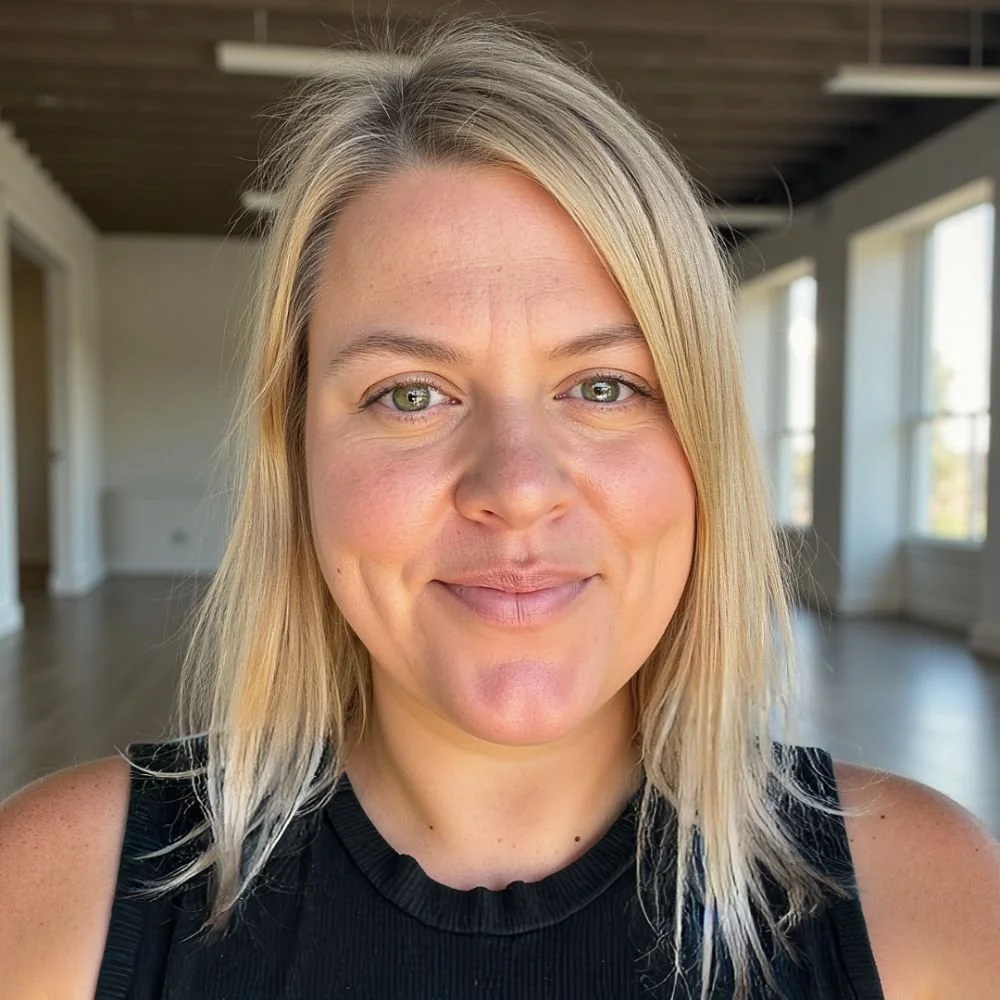
Kristine Neil
Fractional Web Partner
I'm Kristine Neil - a communications strategist who has spent 20+ years designing websites, first running a full-scale design and marketing agency, and now leading my own studio. I've been the creative director managing the work, the coder quietly fixing what others couldn't, and the strategist in the room asking why before how. Somewhere between the MBA and the other degrees, I decided web design was just one tool in a much bigger toolbox - the real work is figuring out what you're trying to say, who needs to hear it, and what's getting in the way. A website is just where all of that comes to life.
I build on Squarespace, and after years deep in the platform I know how far it can go and when to push past its limits. These days, I'm especially drawn to working as a fractional partner - getting to know an organization over time and helping with whatever moves them forward, whether that's a full redesign, an ongoing hand with content and strategy, or just being the person who knows their site best. I write here about eCommerce, web strategy, and making the complex feel a little more human.